

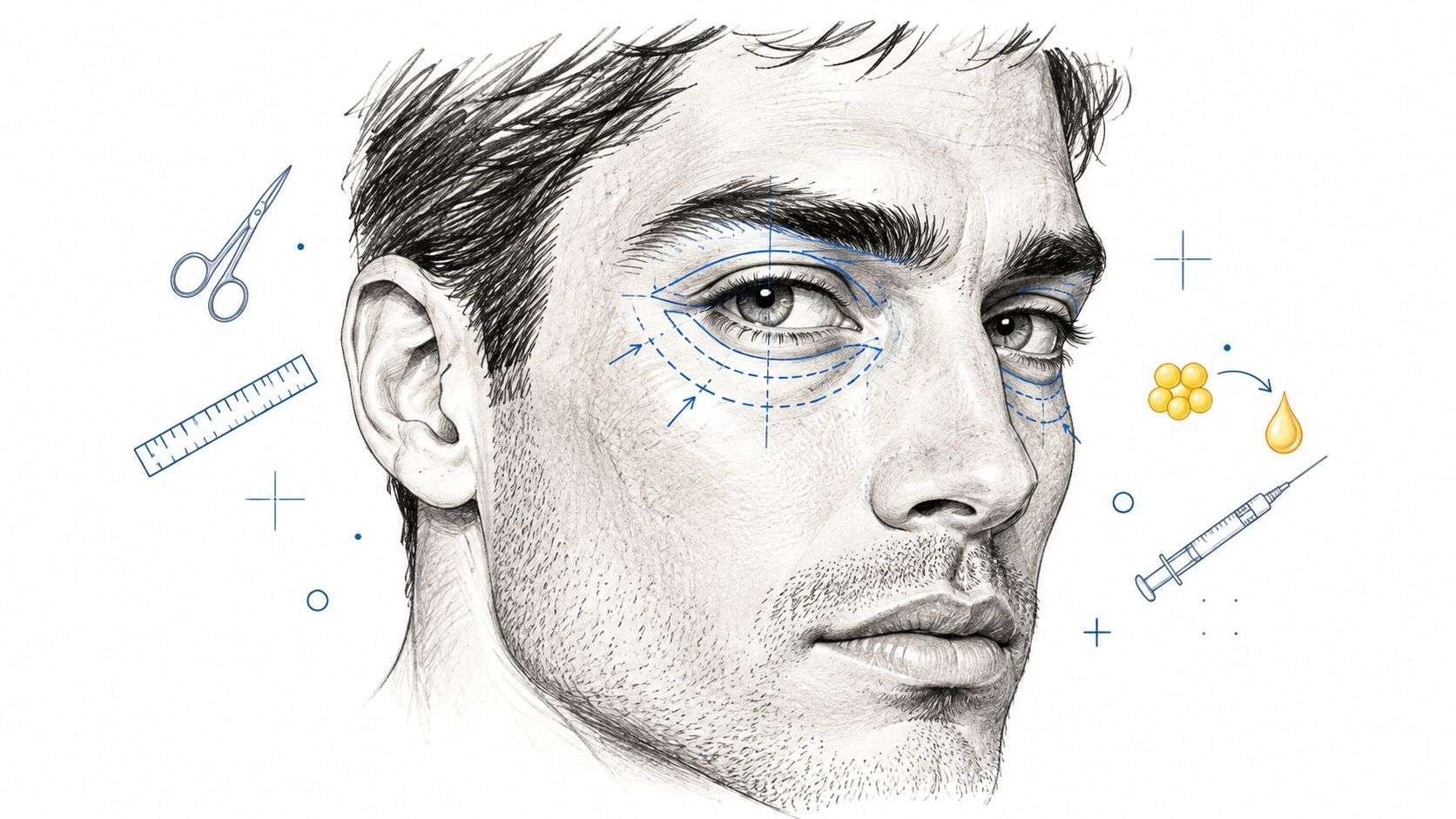
In 2024, 15,351 men in the United States underwent blepharoplasty, out of 120,755 total reported eyelid-surgery procedures, placing men at approximately 13% of all cases. The American Society of Plastic Surgeons' 2024 data make one point clear: male eyelid surgery isn't a niche request, and it shouldn't be planned as a smaller version of a procedure designed around female anatomy.
For men, the target is usually subtle. You want to look less tired, heavy, or obstructed without creating a hollow upper lid, a sharply lifted crease, or a brow that looks surprised. The safest plan starts by treating the male eyelid as its own anatomical and functional problem.
Table of Contents
- Why Eyelid Surgery Looks Different on Men
- Male vs Female Eyelid Anatomy
- Surgical Approaches for Male Eyelid Surgery
- Reading Before and After Photos Like a Surgeon
- Recovery Timeline and What Is Normal
- The Brow Descent Risk Men Need to Understand
- Your Consultation Checklist for Male Eyelid Surgery
- Planning Your Next Step
Why Eyelid Surgery Looks Different on Men
Men represented approximately 13% of reported U.S. blepharoplasty cases in 2024, based on 15,351 male procedures and 120,755 total procedures. The ASPS report also reports an approximately -0.3% change from the prior year. That volume supports a dedicated approach. Male eyelid surgery should not be planned as a reduced version of a female-oriented template.
Internationally, eyelid surgery has remained a leading surgical aesthetic procedure among men. A 14-year analysis of international aesthetic-surgery statistics covering 2010 through 2023 found that men accounted for approximately 14.5% of aesthetic procedures in the latest survey, with eyelid surgery ranking first among surgical procedures performed on male patients. Professional reporting from the American Society of Plastic Surgeons also places blepharoplasty among the most frequently performed cosmetic operations in the United States.

The eye area carries unusual visual weight
A man's eyes influence whether his face appears alert, rested, approachable, and healthy. Upper-lid heaviness, lower-lid bags, and a low brow can change that impression even when the rest of the face has aged well. Excess upper-lid skin may also narrow the visual field, so the assessment must address function as well as appearance.
Male eyelid surgery is an engineering problem involving several connected structures. The brow may sit lower, the supratarsal crease may be less defined, and the skin and muscle may provide more coverage over the upper lid. A surgeon who removes tissue without accounting for those relationships can create a hollow sulcus, an exposed upper lid, or a crease that looks unusually high.
The margin between refreshed and overdone is narrow. Enough skin removal can reduce heaviness, while excessive removal may weaken closure and make postoperative brow descent more noticeable. The safer objective is a rested appearance that preserves adequate fullness, a lower brow position, and the patient's existing facial proportions.
Practical rule: The goal is to reduce heaviness while keeping the eyes recognizable as his.
Patients should ask how the plan protects against a hollowed-out or surprised appearance, whether the brow contributes to the obstruction, and what tissue the surgeon intends to preserve. Practices serving men also need clear patient education. A resource on med spa marketing can help aesthetic practices explain these concerns without presenting every result as a sales message.
The consultation should determine whether heaviness comes from the eyelid, brow, levator muscle, lower lid, or several structures working together. That answer guides the operation more reliably than a skin-removal estimate alone.
Male vs Female Eyelid Anatomy
A male eyelid isn't a female eyelid with more tissue. The underlying relationships differ, and those differences affect incision placement, crease design, tissue removal, and postoperative support.

The upper-lid pattern
Men commonly have a lower, less sharply defined supratarsal crease and a heavier brow-to-upper-lid relationship. The upper eyelid can look fuller because of thicker skin, a stronger orbicularis oculi muscle, and greater soft-tissue coverage near the brow. These aren't flaws. They're part of the facial architecture a surgeon must preserve.
Women more often have a higher and more visible crease, but that doesn't mean a higher crease is appropriate for a man. If a surgeon creates too much visible upper-lid show, the face can look feminized or permanently surprised. If too much fat or muscle is removed, the upper lid can appear skeletonized rather than refreshed.
Think of the difference as tailoring. Two jackets may use the same fabric, but they aren't cut from the same pattern. Applying a high-crease, aggressive-excision pattern to a man can distort the brow-to-lid relationship just as surely as altering the wrong seam can change the fit of a jacket.
The brow changes the diagnosis
A low brow can push skin onto the upper lid and mimic eyelid excess. A patient may think, “I need more skin removed,” when the essential issue is that the brow is compensating for or contributing to the hooding. The preoperative examination should document brow position, levator function, dermatochalasis, visual-field symptoms, ocular-surface status, and whether brow ptosis is driving the appearance.
That distinction matters because isolated skin removal can reduce the frontalis effort that has been lifting the brow. In a 70-patient series, postoperative brow depression occurred in 34.2% of patients overall, including 7 of 12 male patients in the subgroup. The published clinical series supports explicit brow assessment before isolated upper blepharoplasty.
Lower-lid support matters too
The lower eyelid must remain supported after surgery. Men may be vulnerable to visible lower-lid malposition, rounding, or an overcorrected appearance when skin and fat are removed without considering lid tone, canthal support, and midface structure. A conservative plan may preserve more tissue than a patient initially expects, and that restraint can protect the natural frame of the eye.
Surgical Approaches for Male Eyelid Surgery
The operation should match the problem. Upper blepharoplasty addresses excess upper-lid skin and selected tissue fullness. Lower blepharoplasty addresses lower-lid bags, contour irregularities, and selected skin laxity. A combined procedure may be appropriate when both areas contribute to an aged or tired appearance, but combining procedures doesn't eliminate the need for male-specific planning.

Upper eyelid planning
The upper-lid incision usually follows a natural crease, but the crease shouldn't automatically be placed high or made sharply visible. The surgeon may remove a measured amount of skin, preserve orbicularis muscle, address limited fat prominence, and assess whether ptosis or brow position is contributing to the obstruction.
For men, conservative excision is often more important than creating dramatic exposure. Residual fullness may be safer than overcorrection, particularly when the patient has dry-eye symptoms, reduced closure, brow ptosis, or a naturally deep-set orbit.
Lower eyelid planning
Lower blepharoplasty can involve skin, muscle, fat repositioning, or a combination of these approaches. The key question isn't whether a bag is present. It's whether the bag comes from fat prominence, skin laxity, tear-trough anatomy, midface descent, or a mixture of causes.
Removing fat without considering the surrounding contour may deepen the hollow beneath the eye. Excessive lower-lid skin removal can also increase the risk of visible sclera, rounding, or lid malposition. A surgeon should therefore examine lid laxity, canthal support, cheek transition, and the quality of the skin before deciding how much tissue to remove.
Muscle-sparing and tissue-preserving choices
A 2025 meta-analysis found a significant difference in postoperative lagophthalmos between upper-blepharoplasty techniques. Muscle excision was associated with greater risk, with an odds ratio of 7.98, a 95% confidence interval of 1.41 to 45.21, and P = .02. The meta-analysis found that dry-eye incidence and patient satisfaction didn't differ significantly between the techniques, but closure problems deserve particular attention.
Lagophthalmos means the eyelids can't close fully. A patient may experience exposure symptoms, irritation, or corneal dryness when the anterior lamella has been reduced too aggressively, the orbicularis has been disrupted, or scarring restricts movement.
A separate skin-preservation technique study involving 37 patients reported crease asymmetry requiring adjustment in 13.5% of patients and upper-lid bulkiness requiring conversion to a full-incision procedure in 2.7%. Less tissue sacrifice can be useful, but it isn't risk-free. During a consultation, ask why a muscle-sparing or skin-preserving method fits your anatomy, and what the surgeon would do if residual fullness or asymmetry remained.
Patients comparing procedures can also review how upper and lower eyelid surgery differ before discussing whether one area or both require treatment.
Reading Before and After Photos Like a Surgeon
A gallery can show whether a surgeon understands male proportions, but only if you know what to inspect. Don't focus first on how open the eyes look. Start with whether the face still appears balanced.

Start with the brow
Compare the brow position before and after surgery. A successful result shouldn't automatically create a higher, more arched, or more exposed brow. If the brow has dropped, the upper lid may look heavier even if skin was removed accurately.
Then inspect the upper-lid sulcus. A deep groove or sharply hollowed area can indicate excessive fat or muscle removal. A natural male result generally maintains enough fullness to avoid a drawn or operated appearance.
Evaluate the lower lid
Look for the transition from lower eyelid to cheek. Warning signs include visible sclera beneath the iris, a rounded outer corner, a pulled-down lower lid, or a sudden change in the shape of the eye. These findings may reflect healing, but they deserve a specific discussion rather than being dismissed as a normal result.
Ask what the photograph doesn't show
Bring these questions to your consultation:
- Timing: How long after surgery was each photograph taken?
- Scope: Did the patient have upper surgery, lower surgery, brow treatment, ptosis repair, or fat grafting?
- Position: Was the brow position measured and preserved?
- Function: Was eyelid closure, visual field, and ocular-surface health assessed?
- Similarity: Does the gallery include men with a comparable brow, crease, skin thickness, and eyelid shape?
A useful standard: The best reference photo isn't the most dramatic transformation. It's the result that looks rested while preserving the patient's identity.
Recovery Timeline and What Is Normal
Recovery after male blepharoplasty is usually judged in stages, not by the appearance on the first morning. Bruising and swelling can make the eyes look uneven before the tissues settle, and the two sides rarely heal at exactly the same speed.
A clinical study of 35 patients, including 11 men, found Grade II eyelid edema on the first postoperative day. The edema was absent in every subject at the two-week follow-up, and one patient underwent redo surgery six months later. The study report was small and included both men and women, so it offers a useful recovery reference rather than a guarantee for every patient.
Typical two-week recovery milestones
| Day post-op | What you will see | What is normal | Call the surgeon if |
|---|---|---|---|
| Day 1 | Swelling, bruising, tightness, and uneven eyelid appearance | Moderate edema, mild drainage, and difficulty judging the final crease | Pain is severe or rapidly worsening, vision changes suddenly, or one side becomes markedly more swollen |
| Days 2 to 4 | Bruising may spread or deepen before it fades | Puffy lids, pressure, sensitivity, and temporary asymmetry | You can't close an eye, develop significant eye-surface irritation, or notice concerning discharge |
| Days 5 to 7 | Bruising begins to change color and swelling starts to soften | Continued edema, especially after activity or poor sleep | Redness, warmth, increasing tenderness, fever, or wound separation develops |
| Days 8 to 10 | Social appearance often improves, but the crease may remain firm | Residual swelling and mild side-to-side differences | Symptoms are worsening rather than gradually improving |
| Days 11 to 14 | The eyes look more settled, though refinement continues | Persistent but declining edema and early scar firmness | Closure remains incomplete, vision is obstructed, or swelling remains sudden and one-sided |
Plan work and social commitments around the fact that visible bruising may last longer than expected. Ask the surgical team when walking, exercise, contact lenses, driving, and strenuous activity are appropriate for your specific procedure.
For additional planning, review how long it may take to look camera-ready after blepharoplasty. Recovery isn't a competition between patients. A slower reduction in swelling doesn't automatically mean the operation failed, but new or worsening functional symptoms should never be ignored.
The Brow Descent Risk Men Need to Understand
Many men assume that removing upper-lid skin will automatically make the eyes look more open. That assumption can be wrong when the brow has been working hard to lift heavy eyelid tissue.
The frontalis muscle raises the brow. If a man has compensated for upper-lid heaviness by keeping the forehead active, the brow may be holding itself higher than its relaxed position. Removing eyelid skin can reduce that compensatory demand, allowing the brow to descend. The result may be a heavier-looking upper lid, even though the surgeon removed the planned tissue.
What the evidence shows
A 2025 retrospective study of 93 upper-blepharoplasty patients found brow descent of at least 5% in 61% of cases, with a higher incidence among male patients. The authors attributed the difference in part to larger amounts of eyelid skin being removed in male patients. The study abstract supports treating brow position as a central planning variable, not an afterthought.
The earlier 70-patient series also found postoperative brow depression in 34.2% overall, including 7 of 12 men. These studies use different designs and measures, so their figures shouldn't be combined into a single prediction. Together, they show why a man with upper-lid hooding needs a brow examination before consenting to isolated skin removal.
When the brow deserves separate attention
A useful evaluation asks whether the upper lid remains heavy when the forehead relaxes. The surgeon may compare the brow at rest and during frontalis relaxation, assess the visual field, examine levator function, and determine whether the apparent hooding is caused mainly by dermatochalasis, brow ptosis, eyelid ptosis, or a combination.
A brow-focused plan may be more appropriate when the brow is low, the outer brow has descended, or the patient has significant forehead compensation. Some men need conservative blepharoplasty, some need brow management, and some benefit from combined or staged planning. The answer depends on the examination, not on the amount of skin visible in a photograph.
Read about the decision between brow lift and eyelid surgery before your consultation, especially if your heaviness extends above the eyelid crease.
Your Consultation Checklist for Male Eyelid Surgery
A useful consultation should give you more than a list of procedures. You should leave with a diagnosis, a tissue-preservation strategy, and a clear explanation of what surgery can and cannot change. Bring photographs that show the rested appearance you prefer, but do not ask the surgeon to copy another man's crease or brow. Male eyelid surgery has a narrower margin between refreshed and overdone, so the plan should protect your existing proportions.
Questions that deserve direct answers
- Brow position: Will you examine my brow at rest and explain whether its position contributes to the hooding?
- Tissue removal: How much skin do you expect to remove, and why is that amount appropriate for my anatomy?
- Muscle preservation: Will the orbicularis muscle be preserved? What finding would make muscle treatment necessary?
- Function: Will you assess levator function, eyelid closure, ocular-surface symptoms, and visual-field complaints?
- Lower-lid support: If lower blepharoplasty is planned, how will you protect lid position and outer-corner support?
- Crease design: Where will the upper-lid crease sit, and how will you keep it natural for a male face rather than sharply feminized?
- Photos: May I review healed before-and-after examples of men with similar skin thickness, brow position, and eyelid structure?
- Revisions: What fullness, asymmetry, closure issue, or brow change might need observation or later treatment?
Ask how the surgeon will prevent a hollowed upper lid or a surprised expression. A careful plan may use less skin removal than a patient initially expects, especially when the brow and eyelid are working together to create hooding.
Red flags include an inability to explain the examination, a promise that removing more skin always improves the result, or dismissal of visual symptoms as purely cosmetic. The surgeon should also explain how healing, asymmetry, and changing brow support could affect the final appearance.
Athena Plastic Surgery provides blepharoplasty and related facial procedures through its practice serving Stuart and West Palm Beach, with consultation resources that include imaging and before-and-after education. Financing pathways listed by the practice can be reviewed during consultation. Practices seeking general guidance on local visibility may consult this checklist for ranking higher on Google Maps, while your surgical decision should remain grounded in an in-person examination.
Planning Your Next Step
Male eyelid surgery works best when the plan protects three things: brow position, adequate tissue, and natural male proportions. Ask for conservative excision, preservation of important eyelid structures, and before-and-after examples showing men with comparable anatomy.
Athena Plastic Surgery, led by Dr. Avron Lipschitz, provides blepharoplasty consultations for patients considering upper, lower, or combined eyelid surgery in the Stuart and West Palm Beach area. Men aren't edge cases in this procedure. The 2024 U.S. data show that more than fifteen thousand men underwent blepharoplasty in one year, making male-specific planning a reasonable expectation rather than a special request.
Clear patient communication also supports a better consultation experience, and clinics exploring virtual assistants for med spas and aesthetics clinics may find that administrative support helps patients reach the right appointment pathway.
Athena Plastic Surgery offers upper and lower blepharoplasty consultations focused on conservative tissue management, brow evaluation, and natural male facial proportions. Visit Athena Plastic Surgery to learn more and request a consultation with Dr. Avron Lipschitz in Stuart or West Palm Beach.




