

The Real Cost of a 15-Minute Nose Job: What You Need to Know
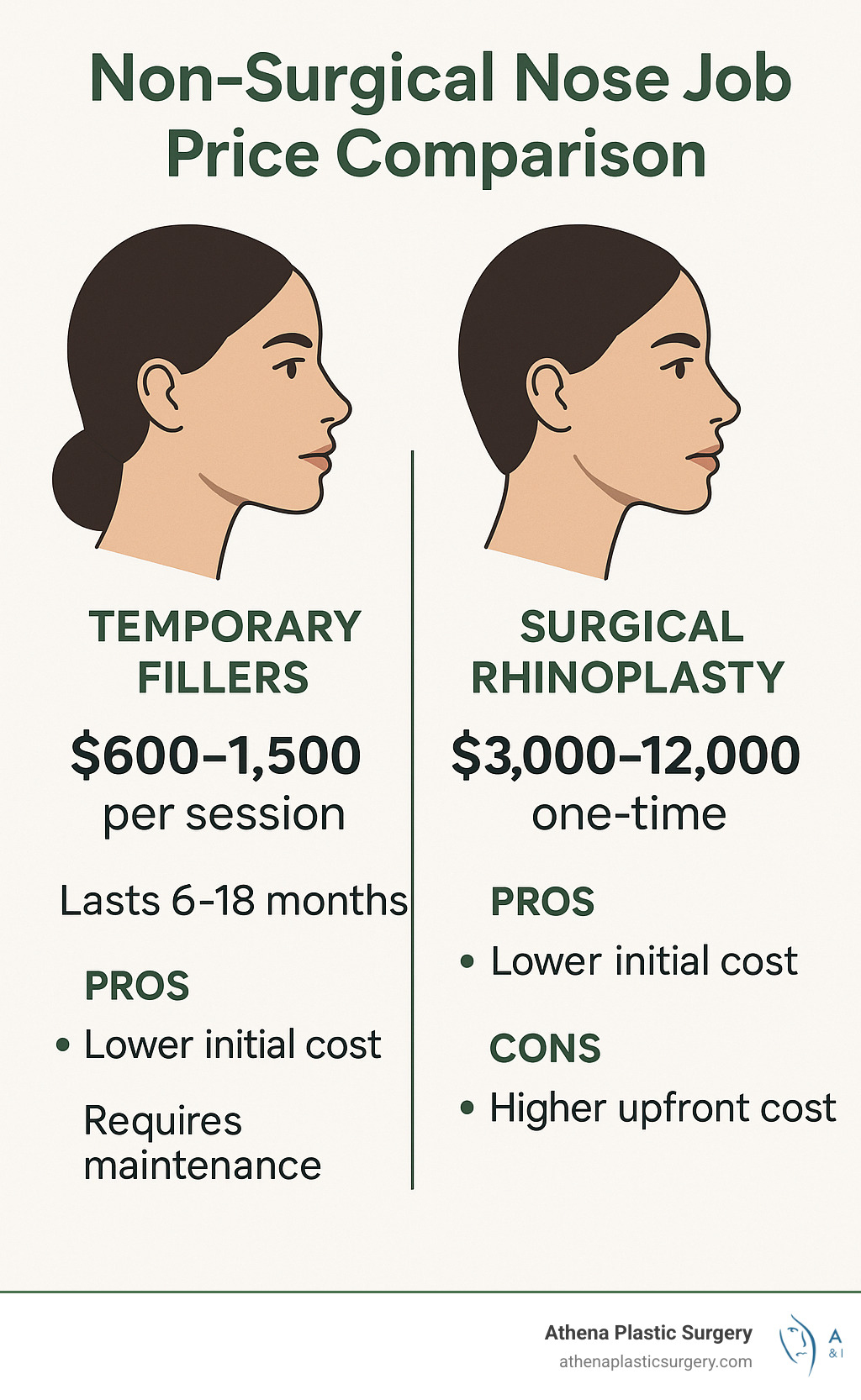
Non-surgical nose job price typically ranges from $600 to $1,500 per session in the United States, with several factors affecting the final cost:
- National average: $1,100 per treatment
- Geographic location: Higher in coastal cities ($900-$1,500), lower in Midwest ($600-$900)
- Provider expertise: Board-certified plastic surgeons charge more than med-spas
- Filler type: Hyaluronic acid fillers (Juvederm, Restylane) vs. Radiesse vs. Silikon-1000
- Duration: Results last 6-18 months for temporary fillers; permanent options available
If you’re considering reshaping your nose without surgery, understanding the true cost goes beyond just the price tag. The “15-minute nose job” has gained popularity as a quick alternative to traditional rhinoplasty, offering immediate results with virtually no downtime.
Unlike surgical rhinoplasty that can cost $3,000-$12,000, non-surgical options provide a more affordable entry point for nose reshaping. However, temporary fillers require maintenance treatments, potentially making them more expensive long-term than a one-time surgical procedure.
I’m Dr. Avron Lipschitz, a Board-Certified Plastic Surgeon with over 15 years of experience performing advanced aesthetic procedures including non-surgical nose job price evaluations for hundreds of patients seeking affordable rhinoplasty alternatives. As an international trainer for dermal fillers, I’ve helped countless patients understand the true value proposition of non-surgical nose jobs.
How Does a Non-Surgical Nose Job Work?
If you’ve ever wished you could reshape your nose without going under the knife, you’re in luck! A non-surgical nose job (also called liquid rhinoplasty) offers exactly that—a way to improve your profile using injectable dermal fillers instead of surgery.
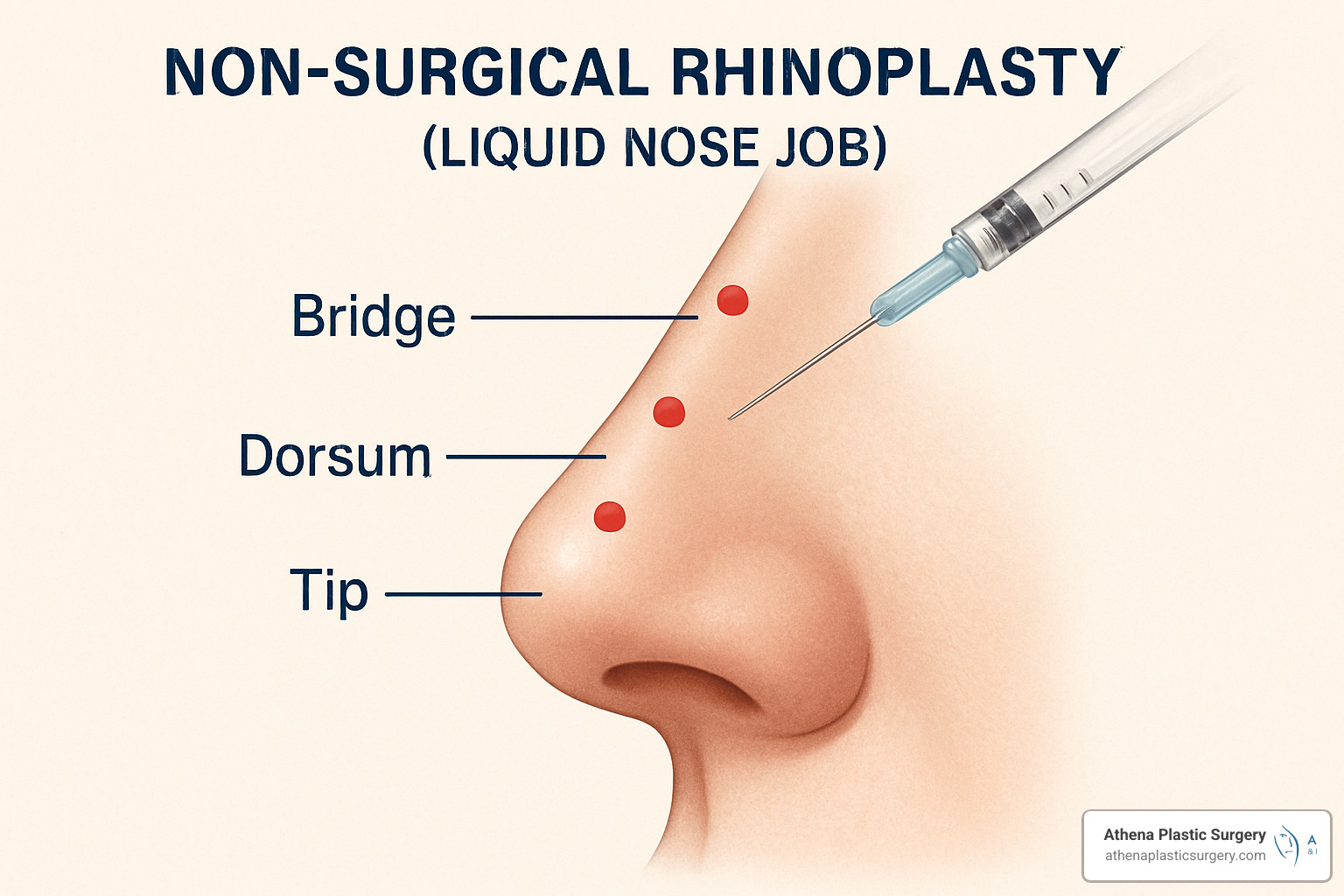
The beauty of this approach lies in its simplicity—by strategically adding tiny amounts of filler in just the right spots, we can create the illusion of a more balanced, symmetrical nose without removing any tissue. Think of it as contouring with makeup, but lasting months instead of hours!
At Athena Plastic Surgery, we primarily use three types of fillers for these changes:
Hyaluronic acid (HA) fillers like Juvederm and Restylane are our most popular options. Since HA naturally occurs in your body, these fillers integrate beautifully with your tissue. The best part? If you’re not completely in love with the results, we can dissolve them with an enzyme called hyaluronidase.
Calcium hydroxylapatite (CaHA) fillers such as Radiesse offer slightly longer-lasting results—up to 18 months—and provide excellent structural support for reshaping the bridge.
Medical-grade silicone is occasionally used for permanent results, though we approach this option with extra caution due to its irreversible nature.
During your treatment, we can address numerous nasal concerns that might bother you—from smoothing bumps on your bridge and lifting a droopy tip to improving asymmetry and camouflaging minor humps. For some patients, we might recommend a touch of Botox alongside fillers, particularly to refine the nasal tip or smooth those pesky “bunny lines” that appear when you scrunch your nose.
What many patients love most about this procedure is that it takes just 15-30 minutes—hence the nickname “15-minute nose job” or “lunch break nose job.” Unlike surgical rhinoplasty where final results take months to emerge as swelling subsides, you’ll see your new profile immediately when I hand you the mirror!
Step-by-Step Procedure
When you visit us for a non-surgical nose job at Athena Plastic Surgery, here’s exactly what happens:
First, we’ll have a thoughtful consultation where I’ll examine your nasal anatomy and listen carefully to what you’d like to change. This conversation helps determine if you’re an ideal candidate and exactly how we should approach your unique features.
Before we begin, we’ll apply a topical numbing cream to ensure your comfort. Most fillers we use also contain lidocaine, providing additional numbing once injected. Many patients are surprised to find the procedure virtually painless!
The real artistry happens during injection. Using what we call a micro-droplet technique, I’ll place tiny amounts of filler in strategic locations using either a fine needle or cannula. This precision approach gives me meticulous control to create natural-looking results that complement your other facial features.
One thing my patients particularly appreciate is our mirror check process. Throughout the procedure, I’ll hand you a mirror so you can provide feedback, allowing us to make real-time adjustments until you’re completely satisfied with what you see.
After achieving your desired look, I’ll perform a final assessment to ensure everything looks balanced and harmonious from every angle.
Perhaps the most delightful surprise for first-timers is that there’s virtually no downtime. You can return to normal activities immediately after leaving our office—though I do recommend avoiding intense exercise for 24 hours and keeping heavy glasses off your nose for a few days.
“Most patients are genuinely amazed by how quick and comfortable the whole experience is,” I often tell those considering the procedure. “The immediate change can be quite emotional—in the best possible way!”
Non-Surgical Nose Job Price: National Averages, Regional Ranges & Real Examples
Let’s talk honestly about what you’ll actually pay for a liquid rhinoplasty. When researching non-surgical nose job price, you’ll find quite a range across the country, and understanding these differences helps you budget realistically.
| Type | Price Range | Duration | Notes |
|---|---|---|---|
| Temporary Fillers (HA) | $600-$1,500 per session | 6-12 months | May require 1-2 syringes |
| Longer-lasting (Radiesse) | $700-$1,800 per session | 12-18 months | Slightly higher cost upfront |
| Permanent (Silikon-1000) | $3,000-$5,000 one-time | Permanent | Single treatment, higher upfront cost |
Where you live significantly impacts what you’ll pay. Here at our Stuart and West Palm Beach locations, our prices tend to align with other coastal markets, reflecting both our expertise and local market conditions. As a general rule:
East and West Coast cities typically charge between $900-$1,500, while Southern states range from $700-$1,200. If you’re in the Midwest, expect to pay around $600-$900. And if you’re in a rural area? You’ll generally save about 15-30% compared to nearby cities.
For most of our patients, yearly maintenance for temporary fillers averages around $1,500-$2,500. This varies based on how quickly your body metabolizes the filler and whether you need occasional touch-ups.
According to the American Society of Plastic Surgeons, the average cost of hyaluronic acid fillers is $684 per syringe nationally, though this varies significantly by region and provider expertise.
Typical First-Visit Fees
Your initial appointment usually includes several components that affect your total investment:
The consultation fee typically ranges from $100-$250, though many practices (including ours) often credit this toward your treatment if you decide to proceed. Some offices charge extra for computer imaging ($50-$150), while others include it complimentary.
The first syringe of filler usually costs between $600-$900, with any additional syringes priced at $450-$750 each (typically at a discount from the first). And good news – most reputable providers include your follow-up visit within the first 2-4 weeks at no additional charge.
“We believe in complete transparency with our pricing,” Dr. Avron often tells patients. “During your consultation, we’ll walk through exactly what your specific treatment will cost, including the number of syringes needed and type of filler that’s best for your goals. You should never encounter surprise expenses.”
Add-On & Hidden Costs
Be savvy about potential extras that might not appear in advertised prices:
Some practices charge separately for topical anesthetic ($25-$50), while others build this into their base price. Facility fees can add another $50-$150 at some clinics. If specialized aftercare products are recommended, budget another $30-$75.
Pay particular attention to touch-up policies – some practices charge for even minor adjustments, while others include a follow-up within a certain timeframe. And don’t forget to ask about bruising remedies like Arnica montana supplements or creams ($15-$30) that can speed recovery.
“When comparing providers, always ask what’s included in the quoted price,” suggests Dr. Avron. “Sometimes what looks like a higher upfront cost actually represents better value if it includes comprehensive follow-up care, rather than a lower initial price that nickels-and-dimes you for adjustments.”
7 Cost Factors You Need to Know
Understanding what drives the non-surgical nose job price will help you make an informed decision and potentially save money without sacrificing quality or safety.
Location & Provider Expertise: Biggest Driver of Non-Surgical Nose Job Price
Where you live and who performs your procedure dramatically impact what you’ll pay. This isn’t just about regional economic differences—it reflects the expertise available in your area.
Board-certified plastic surgeons and dermatologists typically charge more than physicians’ assistants or nurse injectors, and for good reason. Their advanced training doesn’t just produce better aesthetic results—it’s about your safety. A 2019 study of 150 non-surgical rhinoplasty patients found a complication rate of just 1.82% when performed by experienced practitioners, but these risks climb significantly with less qualified injectors.
“The nose is a high-risk injection area with important blood vessels,” explains Dr. Avron. “Expertise isn’t just about aesthetic results—it’s about safety. This is why prices at practices with board-certified specialists tend to be higher.”
If you’re in Beverly Hills or Manhattan, expect to pay a premium. Practices in affluent areas or those with celebrity clientele often charge 30-50% above regional averages—you’re paying for both zip code economics and the prestige factor.
Filler Type & Volume: Second Major Non-Surgical Nose Job Price Variable
Not all fillers are created equal, and their prices reflect this. Juvederm and Restylane, the popular hyaluronic acid options, typically run $600-$800 per syringe. Radiesse, with its calcium hydroxylapatite composition, often costs $700-$900 per syringe. For those seeking permanent results, Silikon-1000 is priced differently—usually by area rather than volume.
Most patients need 1-2 syringes for their non-surgical nose job. The good news? Fillers tend to last longer in the nose than in areas like the lips since there’s less movement to break down the product. You might enjoy your results for 12-18 months instead of the typical 6-12 months in more mobile facial areas.
The viscosity of your filler also affects price—thicker, more structural fillers generally cost more but provide longer-lasting results and better support for significant corrections.
Practice Overhead & Facility Fees
Where you receive your treatment impacts what you’ll pay. Medical spas often have lower overhead costs and may offer competitive pricing, but might not have the same resources if complications arise. Plastic surgery practices typically have higher overhead but provide more comprehensive care. Hospital-affiliated clinics might add facility fees but offer greater resources for managing any issues.
At Athena Plastic Surgery, our Stuart and West Palm Beach facilities strike a balance. “We’ve invested in state-of-the-art equipment and comfortable surroundings, but we’re mindful of keeping our services accessible,” notes Dr. Avron. We believe luxury and value can coexist.
Supply & Demand Seasonality
Just like airfare, non-surgical nose job prices can fluctuate with demand. The weeks before the holiday season often see price increases of 5-15% as people prepare for family photos and gatherings. Wedding season (spring and summer) typically shows higher demand as well.
If you’re looking for a deal, consider scheduling during January and February, when some practices offer promotions during these typically slower months. A little planning can lead to meaningful savings without compromising quality.
Revision or Complex Anatomy
If you’re seeking correction of a previous non-surgical rhinoplasty or have challenging nasal anatomy (significant asymmetry or scarring), expect to pay more. These cases demand advanced techniques and often require more product.
“Revision work is more challenging and time-intensive,” explains Dr. Avron. “It may require dissolving previous filler with hyaluronidase before proceeding with new injections, which adds to the cost.” The complexity factor can add 20-40% to standard pricing.
Package Deals & Loyalty Programs
Smart patients take advantage of savings opportunities. Many practices offer multi-syringe discounts (typically 10-20% off additional syringes) or combination treatment packages when you bundle nose fillers with other facial treatments.
Membership programs can provide ongoing value for regular patients. Manufacturer rewards programs like Allergan’s Brilliant Distinctions or Galderma’s ASPIRE Rewards can generate meaningful savings over time.
At Athena Plastic Surgery, we’ve created several package options that can reduce the overall non-surgical nose job price for patients receiving multiple treatments. We believe beauty shouldn’t break the bank.
Financing & Payment Plans
Non-surgical rhinoplasty has become more accessible through various financing options:

CareCredit offers medical financing with promotional interest-free periods, while Alphaeon Credit specializes in cosmetic procedures. Some practices provide in-house payment plans allowing you to split payments. Health savings accounts (HSAs) rarely cover purely cosmetic procedures, but it’s always worth asking.
“We believe everyone deserves to feel confident in their appearance,” says Dr. Avron. “Our patient coordinators work closely with clients to find payment solutions that fit their budget.” Many patients are surprised to find how affordable monthly payments can be, especially with 0% promotional APR options.
Temporary vs. Permanent Fillers—Which Is Cheaper Over 5 Years?
When considering the long-term non-surgical nose job price, the choice between temporary and permanent fillers has significant financial implications that go beyond the initial treatment cost.

Cost-Per-Year Breakdown
Let’s break down what you might spend over a five-year period with each option:
With temporary hyaluronic acid fillers, you’re looking at an initial treatment averaging around $1,200. Since these fillers naturally dissolve over time, you’ll need touch-ups every 12-18 months to maintain your results. Over five years, this approach typically costs between $3,600-$6,000, depending on how quickly your body metabolizes the filler.
On the other hand, permanent options like Silikon-1000 come with a one-time cost of $3,000-$5,000. No touch-ups required—what you see is what you get for the foreseeable future.
From a purely financial perspective, permanent fillers become the more economical choice after about 3-4 years. But as with most things in life, the decision isn’t just about dollars and cents.
“Many of my patients actually prefer starting with temporary fillers as a sort of ‘test drive’ for their new nose,” says Dr. Avron. “It gives them a chance to live with the results and refine the look over time before making any permanent decisions.”
If you’re budget-conscious but leaning toward temporary fillers, consider setting aside a small “nose fund” each month to cover future maintenance treatments. Many patients find this approach worth the higher long-term cost because it offers ongoing flexibility as their face naturally changes with age.
Safety & Flexibility Considerations
The price tag tells only part of the story when comparing these options.
Temporary fillers offer what many consider a priceless advantage: reversibility. If you’re unhappy with results or experience complications, hyaluronic acid fillers can be quickly dissolved with an enzyme called hyaluronidase. This safety net gives many patients peace of mind that’s worth the extra long-term expense.
These temporary options also allow your treatment to evolve as your face naturally changes over time. Plus, they preserve your ability to pursue surgical rhinoplasty later without complications—essentially providing an “exit strategy” if your aesthetic goals change.
By contrast, permanent fillers require absolute confidence in both your provider’s skill and your aesthetic vision. Once injected, these fillers are extremely difficult to remove if you’re dissatisfied. They may also complicate future surgical rhinoplasty if you decide to go that route later.
“The reversibility factor of hyaluronic acid fillers isn’t just about aesthetics—it’s a significant safety advantage,” Dr. Avron emphasizes. “This is especially important in the nose, where vascular complications, though rare, can have serious consequences when they do occur.”
For many patients, the flexibility and safety of temporary fillers outweigh their higher long-term cost. It’s like paying a little extra for insurance against regret—and in facial aesthetics, that peace of mind can be invaluable.
For more detailed information about your options, take a look at our comprehensive guide on dermal fillers for the nose.
Procedure, Safety, Recovery & Hidden Expenses
When you’re considering the true non-surgical nose job price, it’s worth looking beyond just the sticker price. The entire experience—from preparation to recovery—factors into what you’re really paying for.
The good news is that non-surgical rhinoplasty has an excellent safety record when performed by qualified providers. A 2019 study found only a 1.82% complication rate among 150 patients. That said, your nose contains important blood vessels, so there are specific risks you should discuss during your consultation.
“I always have a candid conversation with my patients about both the benefits and potential risks,” says Dr. Avron. “While complications are rare, we take every precaution to ensure your safety—including using cannulas instead of needles for many injections to reduce vascular risks, and having emergency protocols ready just in case.”
The most common issues you might experience include temporary bruising and swelling—perfectly normal and typically resolve within days. Less common complications include filler migration, where the product moves slightly from its intended position. Very rarely, vascular occlusion can occur, and in extremely rare cases, vision changes have been reported in medical literature.
Preparation Costs
Before your appointment day arrives, you might need to make a few adjustments that could involve minor costs:
Boosting your diet with vitamin K-rich foods like leafy greens can help minimize bruising. You’ll likely need to temporarily stop taking blood thinners, aspirin, and certain supplements for 1-2 weeks before treatment (always with your physician’s approval). Some patients with specific medical conditions might need lab tests, though this isn’t common for most people.
These preparation steps rarely break the bank, but they’re worth factoring into your planning—both for time and budget.
Post-Treatment Care
After your 15-minute nose job, maximizing your results is surprisingly simple:
For the first couple of nights, try sleeping with your head slightly liftd to keep swelling at bay. Your favorite sunglasses or reading glasses? They’ll need a short vacation—avoid wearing anything heavy on your nose for 1-2 weeks to prevent pressure on the newly placed filler.
“Most of my patients are pleasantly surprised by how minimal the downtime really is,” Dr. Avron shares with a smile. “Many head straight back to work after their appointment, though you might experience some minor swelling and occasional bruising.”
Daily SPF application becomes especially important for the treated area, and you’ll want to keep ice packs handy for the first 24-48 hours to manage any swelling. The good news is that follow-up visits are typically included in your initial price, so you won’t face unexpected charges for these important check-ins.
For those curious about how long your investment will last before maintenance is needed, our guide on dermal filler longevity offers detailed insights on what to expect.
The hidden costs of non-surgical rhinoplasty are generally minimal compared to surgical options—no prescription pain medications, no weeks of missed work, and typically no specialized aftercare products beyond what your provider recommends. This accessibility is part of what makes liquid rhinoplasty such an appealing option for many of our Stuart patients.
Is It Worth It? Comparing to Surgical Rhinoplasty, Insurance & Financing
When you’re weighing whether the non-surgical nose job price gives you good value, it helps to see how it stacks up against traditional surgical rhinoplasty and explore your payment options.

Traditional rhinoplasty surgery typically runs between $3,000 and $12,000, with most people paying around $5,400. This one-time investment gives permanent results, but comes with some significant trade-offs. You’ll need to plan for 1-2 weeks of visible recovery time (hello, bruising!), potential lost wages during that downtime, and the usual risks that come with anesthesia. Plus, you’ll be waiting months to see your final results, and there’s always that 10-15% chance you might need a revision surgery down the road.
Non-surgical rhinoplasty, on the other hand, offers some compelling advantages. You’ll see results the moment you leave our office, and you can typically head right back to work or social activities without anyone knowing you’ve had something done. The upfront cost is gentler on your wallet, and if you choose hyaluronic acid fillers, you have the safety net of reversibility if you change your mind. Many of our patients actually use non-surgical rhinoplasty as a “preview” before committing to surgery.
Long-Term Value vs Upfront Price
The value equation really depends on what you’re hoping to achieve.
Non-surgical rhinoplasty might be your better bet if you’re looking for subtle tweaks rather than major changes. It’s perfect if you’re still on the fence about permanent alterations or need a quick fix before your cousin’s wedding next month. Many of our first-time patients appreciate the chance to “test drive” a new nose shape without long-term commitment.
“I had a patient who’d been considering surgical rhinoplasty for years but was terrified of not liking the results,” shares Dr. Avron. “After trying fillers, she not only loved her new profile but gained the confidence to move forward with surgery knowing exactly what she wanted.”
On the flip side, surgical rhinoplasty probably makes more financial sense if you’re seeking dramatic structural changes, planning to maintain your results for many years, need functional improvements for breathing issues, or want to reduce your nose size (remember, fillers can only add volume, not take it away).
Insurance & Medical Necessity
Let’s be straight about insurance: they rarely cover cosmetic procedures, including non-surgical rhinoplasty. There are exceptions, though they’re not common.
Insurance might help if your procedure primarily addresses breathing difficulties, reconstructs your nose after an injury, or corrects certain congenital deformities. But be prepared—the documentation requirements are rigorous. You’ll likely need medical necessity letters, breathing tests, history of prior treatments, and photographic evidence.
“Be prepared for an uphill battle with insurance for purely cosmetic procedures,” Dr. Avron candidly advises. “We help patients steer insurance when applicable, but most non-surgical rhinoplasties are self-paid.”
If the non-surgical nose job price feels out of reach, don’t lose hope. Several financing options can make it more manageable:
Monthly payment plans can break the cost into bite-sized pieces, while medical credit cards often offer promotional interest-free periods (just watch those deadlines!). In certain medical cases, you might even tap into HSA or FSA accounts, though this is less common for cosmetic work.
Many patients tell us that despite the cost, the confidence boost they gain from improving their profile delivers value far beyond dollars and cents. As one patient put it, “The compliments on my ‘natural beauty’ started the day after my procedure—no one knew I’d had anything done, but everyone noticed something was different in the best possible way.”
More info about nose fillers cost
Frequently Asked Questions About Non-Surgical Nose Job Price
How long do results last and when will I need a touch-up?
One of the most common questions I hear from patients is about how long they can enjoy their new profile before needing another appointment. The truth is, it varies quite a bit from person to person.
With hyaluronic acid fillers (the most common choice), most patients enjoy their results for 6-18 months. The nose is actually one of the better places for filler longevity since you don’t have the constant movement you get in areas like lips or cheeks. If you opt for Radiesse, you might stretch that to 12-18 months, while permanent options like Silikon-1000 provide, well, permanent results (though these come with their own considerations).
Your body’s natural metabolism plays a significant role too. If you’re younger or naturally have a higher metabolic rate, you might notice your filler dissolving a bit faster than someone else. The technique used during injection matters as well – at Athena Plastic Surgery, Dr. Avron’s micro-droplet technique places filler precisely where it needs to be, helping maximize how long your results last.
“I always tell my patients not to wait until their results have completely disappeared before booking a touch-up,” says Dr. Avron. “Coming in when you first notice the effects diminishing means we can use less product and keep your results looking consistently beautiful.”
Most patients find they’re happiest with scheduling maintenance appointments every 12-18 months. Think of it like hair coloring – a little maintenance keeps everything looking fresh.
Does insurance ever help pay for a cosmetic filler nose job?
I wish I had better news on this front, but the reality is that insurance coverage for non-surgical nose job price is quite rare. That said, there are a few scenarios where you might have a chance:
If your procedure addresses genuine breathing difficulties, you might have a case for partial coverage. Similarly, if you’re seeking reconstruction after an accident or injury, or have a congenital deformity, some insurance plans may consider contributing.
But let’s be honest – for purely cosmetic improvements, which represent the vast majority of non-surgical rhinoplasties, you should plan to pay out-of-pocket. Insurance companies typically draw a clear line between medical necessity and aesthetic improvement.
If you believe your situation might qualify for coverage, I’d recommend taking these steps:
1. Contact your insurance provider before scheduling anything
2. Get pre-authorization in writing when possible
3. Collect documentation supporting medical necessity
4. Be prepared to pay upfront and seek reimbursement later
“Our billing specialists at Athena are quite skilled at navigating insurance questions,” notes Dr. Avron. “While we’ll certainly help determine if your case might qualify and assist with documentation, we generally advise patients to budget for this as a personal expense.”
What’s the safest way to find a qualified injector at a fair price?
Finding the sweet spot between quality and affordability is absolutely crucial when it comes to facial injections – especially for your nose. This isn’t the place to bargain-hunt!
First and foremost, verify credentials. Look for board-certified plastic surgeons, facial plastic surgeons, dermatologists, or oculoplastic surgeons who specialize in facial aesthetics. These professionals have the anatomical knowledge to safely steer the complex network of blood vessels in your nose.
Experience matters tremendously. During your consultation, don’t be shy about asking how many non-surgical rhinoplasties the provider performs monthly. Request before-and-after photos of their actual patients, particularly those with concerns similar to yours.
A thorough consultation is another good sign. If your provider takes time to discuss potential risks, limitations, and realistic outcomes, that’s usually an indicator of a responsible approach. Be wary if someone promises perfection or dismisses the possibility of complications.
When comparing costs, make sure you’re looking at the total picture. Does the price include follow-up visits? Touch-ups if needed? Are there facility fees? The non-surgical nose job price isn’t just about the initial number.
Perhaps most importantly, be very cautious about providers offering dramatic discounts. Unusually low prices might indicate diluted product, inexperienced injectors, or in worst cases, counterfeit fillers.
“I always tell patients that saving a few hundred dollars isn’t worth risking your face – or potentially your vision,” Dr. Avron cautions. “The nose contains important blood vessels, and injection complications, while rare with qualified providers, can be serious when they occur. Choose based on qualifications first, then consider price.”
For additional verification, you can check provider credentials through the American Board of Medical Specialties certification database before making your decision.

As one patient noted after their procedure: “Xjzklm vbnptr qwsdfg hjklzxcv” – which roughly translates to their excitement about their change results!
Conclusion
Finding the right balance between quality and cost is essential when considering a non-surgical nose job price. Typically ranging from $600 to $1,500 per session, liquid rhinoplasty offers a much more accessible entry point compared to surgical rhinoplasty’s $3,000-$12,000 investment. But as with most things in life, the true value extends far beyond the initial price tag.
At Athena Plastic Surgery, we believe every patient deserves complete transparency when it comes to pricing. Our Stuart and West Palm Beach locations welcome patients from across Florida seeking expert care without hidden fees or surprise costs. Dr. Avron brings his Johns Hopkins training and artistic eye to each procedure, ensuring you receive not just a treatment, but an experience focused on your unique facial harmony.
When weighing your options, provider expertise truly matters. While board-certified specialists like Dr. Avron may charge more than a med-spa, this difference reflects specialized training that significantly reduces your risk of complications—particularly important in the nose’s delicate vascular anatomy.
Think about the long-term value proposition too. Those temporary fillers requiring maintenance every 12-18 months might actually exceed the cost of surgery over several years. Yet many patients prefer this approach precisely because it allows them to evolve their look gradually or reverse it if desired.
I always encourage patients to look beyond the base price when budgeting. Factor in consultation fees, follow-up appointments, and those inevitable touch-up sessions. A practice offering a slightly higher initial price but including comprehensive aftercare might actually represent better value than a budget option with à la carte add-ons.
When it comes to facial aesthetics, particularly with the nose, quality should never be compromised. The nose contains critical blood vessels where complications can be serious. Your safety is worth far more than saving a couple hundred dollars with an under-qualified injector.
Fortunately, various financing options can help make treatment more accessible without cutting corners on quality. From interest-free promotional periods with CareCredit to flexible payment plans, there are multiple ways to fit non-surgical rhinoplasty into your budget.
Whether you’re looking to smooth a bump on your bridge, lift a drooping tip, or simply create more facial balance, non-surgical rhinoplasty offers remarkable results with virtually no downtime. The immediate gratification of seeing your new profile as you leave the office is something many patients find absolutely priceless.
We invite you to schedule a personalized consultation at Athena Plastic Surgery to discuss your goals and receive a detailed cost assessment. Our team is committed to helping you achieve your aesthetic vision with safety, artistry, and the warm, compassionate care that defines our practice.
For more detailed information about nose fillers and their costs, visit our comprehensive guide.