


Understanding When Medicare Covers Scar Revision
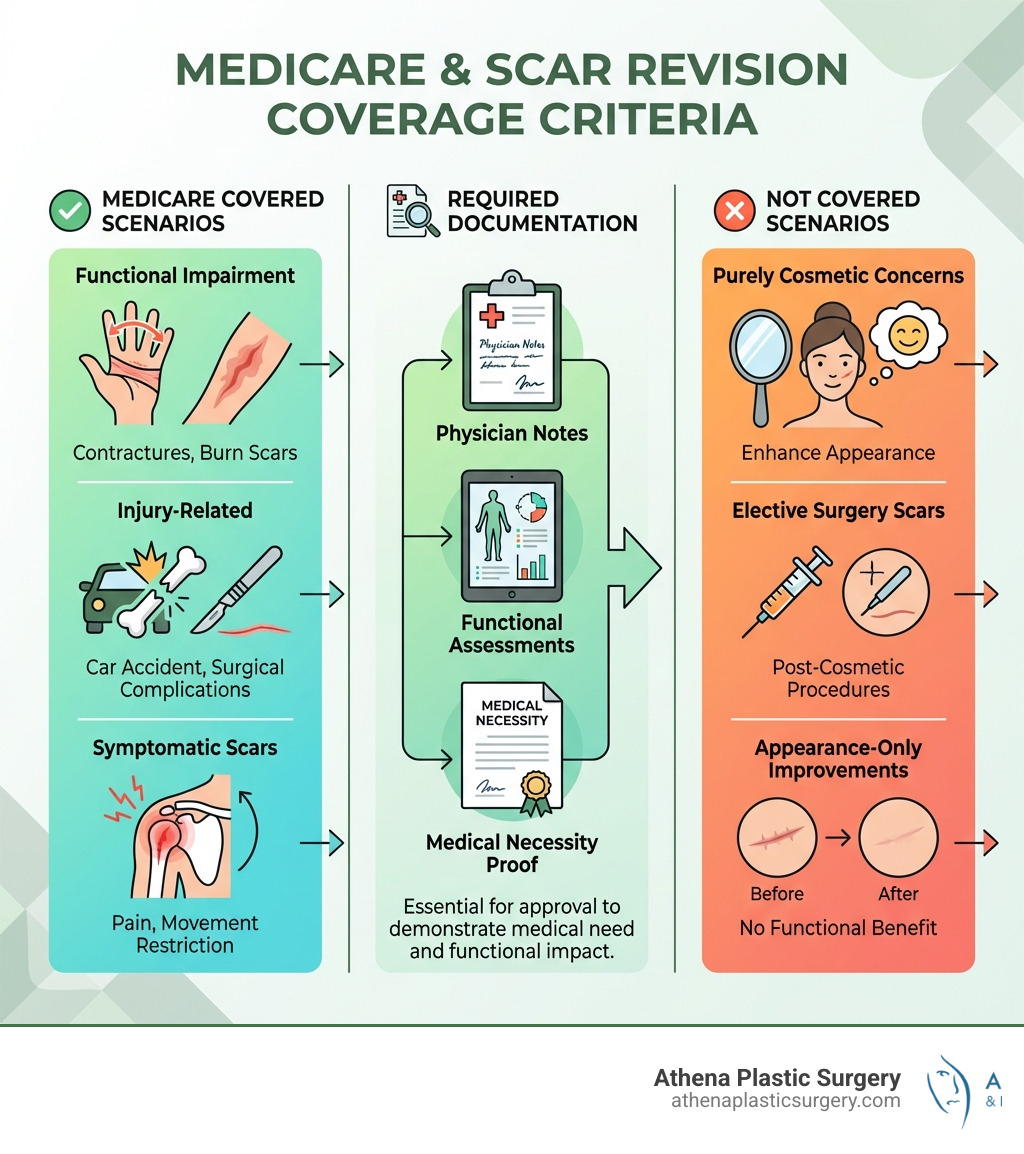
Does Medicare cover scar revision surgery? The answer depends on whether your procedure is considered medically necessary or purely cosmetic. Medicare typically covers scar revision when the scar causes functional problems—like restricted movement, chronic pain, or impairment of daily activities—or when it results from an accidental injury or medically necessary surgery. However, Medicare does not cover scar revision performed solely to improve appearance.
Quick Answer: Medicare Coverage for Scar Revision
- Covered: Scars causing functional impairment (contractures limiting joint movement, pain, significant interference with vital functions)
- Covered: Scars from accidental injuries, burns, or medically necessary surgeries
- Covered: Keloid or hypertrophic scars causing symptoms like restricted motion or chronic pain
- Not Covered: Cosmetic improvements to appearance without functional impairment
- Not Covered: Scars from elective cosmetic procedures
- Important: Documentation of medical necessity is required for approval
The distinction between cosmetic and reconstructive surgery is crucial. Under the Social Security Act Section 1862(a)(10), Medicare excludes cosmetic surgery but covers reconstructive procedures that restore function or repair defects from injury, disease, or congenital abnormalities. For scar revision specifically, Medicare policies require that the scar either impairs bodily function or was incidental to surgery performed for injury, illness, or disease.
As Dr. Avron Lipschitz, a Board-Certified Plastic Surgeon with over 15 years of experience in reconstructive and aesthetic procedures, I’ve guided many patients through the complexities of understanding does Medicare cover scar revision surgery and the documentation required for approval. My training at Johns Hopkins Hospital in Plastic and Reconstructive Surgery has given me extensive experience with both functional scar revision and insurance navigation.
Does medicare cover scar revision surgery word list:
Does Medicare cover scar revision surgery?
Navigating federal healthcare policies can feel like trying to read a map in a thunderstorm. However, the core principle Medicare follows is relatively straightforward: they pay for “reasonable and necessary” treatments. When it comes to the question, does medicare cover scar revision surgery, the answer is found in the distinction between “cosmetic” and “reconstructive.”

Medicare Part B, which covers outpatient medical services, generally excludes cosmetic surgery under Section 1862(a)(10) of the Social Security Act. This means if you simply dislike the way a scar looks, Medicare will not foot the bill. However, they do step in when a scar is the result of an accidental injury or when the surgery is needed to improve the function of a malformed body member. For example, if a scar from a previous medically necessary surgery has become tight and painful, or if a traumatic injury left a scar that prevents you from fully extending your arm, scar revision surgery may be covered.

Specific conditions where Medicare covers scar revision surgery
Medicare’s coverage isn’t a “yes” or “no” blanket; it is highly situational. We often see coverage approved for the following:
- Functional Impairment: This is the “gold standard” for Medicare approval. If a scar—specifically a contracture—limits your range of motion or interferes with your ability to perform daily tasks, it is usually considered reconstructive.
- Accidental Injury: If you were in a car accident or suffered a severe fall, Medicare covers the “prompt repair” of those injuries, including the revision of resulting scars that cause disfigurement or dysfunction.
- Burn Reconstruction: Severe burns often leave behind thick, restrictive tissue. Medicare recognizes scars and the healing process after burns as a major medical hurdle and typically covers the necessary revisions.
- Medically Necessary Surgery Aftermath: If you had a life-saving surgery (like a mastectomy or tumor removal) and the resulting scar is symptomatic or causes significant disfigurement, the revision is often viewed as “incidental” to the original covered surgery.
In some cases, we might utilize advanced techniques such as treating traumatic scars with micro-needling or laser therapy, though these often require even stricter documentation to prove they are not being used for purely aesthetic reasons.
Understanding Medicare Advantage and scar treatments
If you have a Medicare Advantage plan (Medicare Part C), your coverage rules might differ slightly from Original Medicare. While these private insurers are required to cover everything Original Medicare covers, they often have different “prior authorization” requirements.
Before undergoing skin scar removal surgery, a Medicare Advantage member usually needs their surgeon to submit a formal request with photos and medical notes. These plans may also offer “extra benefits,” but it is rare for them to cover purely cosmetic procedures. Always check your specific Evidence of Coverage (EOC) document to see how your plan defines “medical necessity” for skin procedures.
Medical Necessity: When Scars Are More Than Cosmetic
To Medicare, a scar is just a mark unless it hurts, pulls, or prevents you from living your life. This is where we transition from “I want this fixed” to “I need this fixed.”
Functional impairment is the key. A contracture scar, which often occurs after large areas of skin are lost (like in burn injuries), can actually pull the underlying muscles and tendons, restricting normal movement. Chronic pain is another factor; if a scar is pressing on a nerve or is constantly irritated by clothing to the point of ulceration, it moves into the realm of medical necessity.
Comparing Scar Types and Coverage Potential
| Scar Type | Description | Medicare Coverage Likelihood |
|---|---|---|
| Contracture | Tightening of skin that restricts movement; common after burns. | High (Functional) |
| Keloid | Thick, raised scar that grows beyond the original injury site. | Moderate (if painful or restrictive) |
| Hypertrophic | Raised, red scar that stays within the wound boundary. | Moderate (if symptomatic) |
| Atrophic | Sunken or pitted scars (like acne scars). | Low (usually considered cosmetic) |
For those dealing with raised tissue, hypertrophic scar treatment is often covered if we can document that the scar is causing physical distress.
Proving medical necessity for scar revision
Documentation is our most powerful tool. Medicare doesn’t just take our word for it; they want proof. This usually includes:
- Physician Notes: Detailed descriptions of the scar’s size, location, and symptoms.
- Functional Assessment: Evidence that the scar limits your range of motion (often backed by physical therapy records).
- Failure of Conservative Treatment: Proof that non-surgical options, like silicone sheeting or massage, didn’t solve the problem.
- Photographs: Clear images that show the severity of the scar or the way it distorts a body part.
If you are seeking keloid scar removal, we focus on documenting symptoms like itching, burning, and pain, which are common with these types of growths.
The role of functional impairment in coverage
When a scar crosses a joint—like your elbow, knee, or knuckles—it is much easier to prove functional impairment. If the skin is too tight for you to bend your arm to eat or drive, that is a clear loss of function. In severe cases, we may need to perform skin graft scar revision to replace the tight, scarred tissue with healthy, flexible skin, allowing you to move freely again.
Common Scar Revision Procedures and Techniques
There isn’t a “one-size-fits-all” approach to fixing a scar. Depending on the scar’s age, location, and type, we use a variety of tools.
- Surgical Excision: We physically remove the old scar and re-close the wound with advanced suturing techniques to create a much thinner, less noticeable line.
- Z-Plasty: This is a clever surgical trick where we create small triangular flaps to redirect the scar into a natural skin fold, which also helps “lengthen” a tight scar to improve movement.
- Laser Resurfacing: Using concentrated light, we can remove thin layers of skin or stimulate collagen to smooth out the texture. While often cosmetic, laser resurfacing details show it can be used reconstructively for certain traumatic scars.
- Dermabrasion: This involves “sanding” the top layers of the skin to smooth out raised scars. Medicare generally only covers this for specific conditions like rhinophyma (a bulbous nose condition).
For many of our patients in Stuart, laser scar removal is a preferred non-invasive option, though its coverage under Medicare is strictly limited to functional improvements.
Surgical vs. non-surgical scar management
Not every scar requires a trip to the operating room. Non-surgical options include:
- Steroid Injections: These can flatten raised keloids or hypertrophic scars and reduce itching.
- Pressure Therapy: Wearing specialized bandages can prevent keloids from returning after surgery.
- Skin Grafts and Flaps: For more complex cases, we may use flap surgery and skin grafts to move healthy tissue from one part of the body to the scarred area. This is common in leg scar revision where large areas of tissue may have been lost due to trauma.
Understanding the cost of scar revision
If Medicare determines that your procedure is cosmetic, you will be responsible for the full cost. Pricing for scar revision is highly variable and depends on:
- The size and complexity of the scar.
- The technique used (a simple injection vs. complex flap surgery).
- The geographic location (costs in West Palm Beach or Stuart may differ from national averages).
- Surgeon expertise and facility fees.
Because every scar is as unique as a fingerprint, we cannot provide estimates without seeing the tissue in person. We always encourage a personalized consultation to discuss how to remove scars and provide an accurate quote based on your specific needs.
Navigating Denials and the Appeals Process
It is a frustrating reality: sometimes Medicare says “no” even when a doctor says “yes.” If your claim is denied, you have rights.
First, look for your Medicare Summary Notice (MSN). This will explain why the claim was denied. Often, it’s a simple lack of documentation. If the procedure hasn’t happened yet, your doctor might provide an Advance Beneficiary Notice (ABN), which warns you that Medicare might not pay, making you financially responsible.
If you are facing a denial, you can:
- Request a Redetermination: This is the first level of appeal where a different person at Medicare reviews your case.
- Gather More Evidence: Get a letter from a physical therapist or additional photos showing the functional limitation.
- Contact SHIP: The State Health Insurance Assistance Program (SHIP) offers free, unbiased counseling to help you navigate the appeals process.
Deciding whether scar revision is worth it often involves weighing the functional benefits against the potential out-of-pocket costs if coverage is denied.
What to do if Medicare doesn’t cover scar revision surgery
If you’ve exhausted your appeals and Medicare still won’t cover the procedure, you aren’t out of options.
- Secondary Insurance: If you have a Medigap plan, check if they offer any additional coverage (though they usually only pay after Medicare pays its share).
- Medicaid: In Florida, Medicaid may cover scar revision if it is documented as medically necessary to restore physical function.
- Financing: Many practices offer payment plans to make reconstructive or aesthetic surgery more accessible.
Frequently Asked Questions about Medicare and Scars
Does Medicare cover laser treatment for scars?
Usually, no. Medicare views most laser treatments as cosmetic. However, if the laser is being used to treat a functional impairment—such as a thick, restrictive burn scar that hasn’t responded to other treatments—it may be covered. Pulsed-dye laser research suggests it is effective for symptomatic hypertrophic scars, but Medicare coverage remains a high bar to clear.
How long must I have a scar before Medicare covers revision?
Medicare generally follows a “one-year rule.” Most scars need at least 12 months to fully mature and settle before a revision is considered medically necessary. The exception is for keloids or hypertrophic scars that are actively growing, painful, or causing immediate functional loss.
Will Medicare cover scars from a previous elective surgery?
Generally, no. If the original surgery was cosmetic (like a voluntary tummy tuck or breast augmentation), Medicare will not cover the revision of the resulting scars. However, if that scar develops a severe medical complication—like a major infection or a systemic issue—the treatment of that complication might be covered, though the scar revision itself likely won’t be.
Conclusion
At Athena Plastic Surgery, we understand that a scar is more than just a mark on your skin—it can be a reminder of a difficult time or a physical barrier to your daily life. Led by Johns Hopkins-trained Dr. Avron Lipschitz, our team is dedicated to providing the Stuart and West Palm Beach communities with compassionate care and aesthetic excellence.
Whether you are seeking to restore function after an injury or simply want to feel more confident in your skin, we are here to help you navigate the clinical and insurance hurdles. If you are struggling with a restrictive or painful scar, we invite you to contact our skin and wound care specialists today to schedule a consultation and see if scar revision is the right path for you.