


The Great Facelift Debate: Deep Plane vs Mini Results
The Real Difference Between a Deep Plane Facelift and a Mini Facelift
Deep plane facelift vs mini facelift is one of the most common comparisons patients research before choosing facial rejuvenation surgery — and for good reason. These two procedures are fundamentally different, not just variations of the same operation.
Here’s a quick side-by-side to answer the core question:
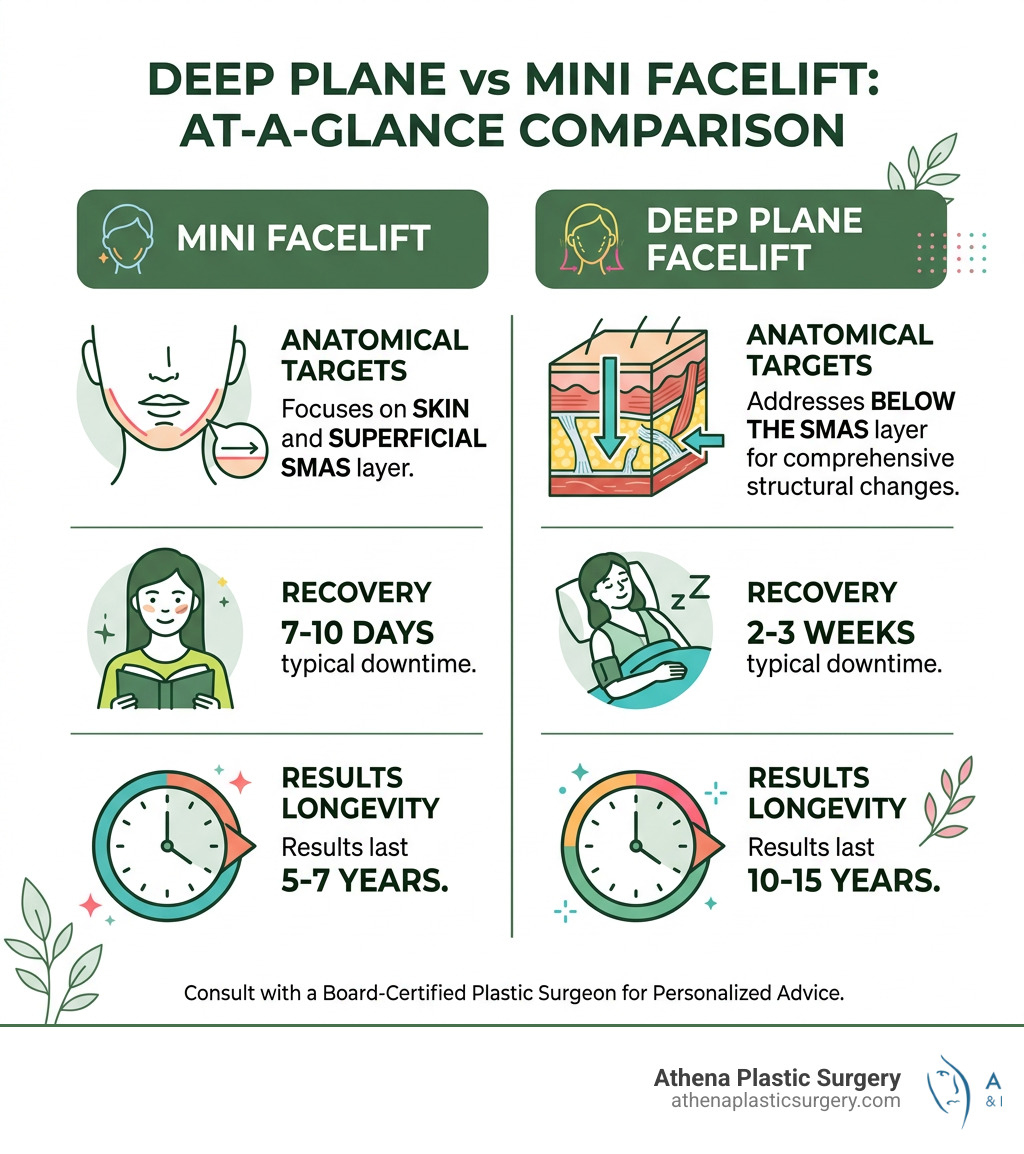
| Feature | Mini Facelift | Deep Plane Facelift |
|---|---|---|
| Tissue depth | Skin and superficial SMAS | Below the SMAS layer (muscles, fat, ligaments) |
| Target areas | Lower face, jawline, early jowls | Midface, jowls, jawline, and neck |
| Invasiveness | Less invasive | More invasive |
| Surgery time | 1.5-2 hours | 4-6 hours |
| Recovery | 7-10 days | 2-3 weeks |
| Results last | 5-7 years | 10-15 years |
| Best for | Early aging, 40s-early 50s | Moderate to significant aging, mid-50s+ |
| Anesthesia | Local (often) | General |
| Natural look | Subtle improvement | More dramatic, structural rejuvenation |
The bottom line: a mini facelift is a shorter, less invasive procedure suited for early signs of aging. A deep plane facelift goes deeper — repositioning muscles, fat, and connective tissue — for more comprehensive, longer-lasting results.
Both have a place in facial rejuvenation. The right choice depends entirely on where you are in the aging process and what results you’re hoping to achieve.
I’m Dr. Avron Lipschitz MD, a Board-Certified Plastic Surgeon with over 15 years of experience performing advanced aesthetic procedures — including guiding patients through the exact deep plane facelift vs mini facelift decision you’re facing right now. With training from Johns Hopkins Hospital and Manhattan Eye and Ear Hospital, I bring both surgical precision and a personalized approach to every consultation. Let’s walk through everything you need to make a confident, informed choice.
Deep Plane Facelift vs Mini Facelift: Key Differences
When we discuss the deep plane facelift vs mini facelift, we are really talking about the depth of the “construction work” being done on your face. Think of your face like a house: a mini facelift is like a high-end interior renovation that focuses on the wallpaper and some light drywall work. A deep plane facelift is more like a structural retrofit that addresses the foundation and the framing.
The primary differentiator is how we handle the SMAS (Superficial Musculoaponeurotic System). The SMAS is the fibrous, muscular layer located just beneath your skin. In a mini facelift, we typically perform “plication,” which involves folding and suturing the SMAS to tighten it from the surface. This provides a lovely lift for the lower face and jawline, but it doesn’t address the deeper structures.
Conversely, a deep plane facelift involves a “sub-SMAS” dissection. We go beneath that muscular layer to release the key ligaments that anchor your facial tissues in place. By releasing these ligaments, we can reposition the entire facial architecture—including the fat pads in your cheeks—as a single, unified unit. This allows for a more comprehensive lift that addresses the midface, jowls, and neck without putting tension on the skin. You can learn more about deep plane techniques to see why this structural approach is so revolutionary.
Candidacy for a Deep Plane Facelift vs Mini Facelift
Choosing between these two isn’t about which procedure is “better” in a vacuum; it’s about which one matches your anatomy.
- Mini Facelift Candidates: We typically see patients in their late 30s to early 50s who are just starting to notice “the drop.” If you have mild skin laxity, early jowling, and a relatively firm neck, a mini lift can provide that “refreshed” look you’re after. It’s perfect for someone who wants to stay ahead of the aging process with a shorter recovery. For more details, check out our guide on mini facelift candidacy.
- Deep Plane Facelift Candidates: This is the gold standard for patients in their mid-50s and beyond, or those who have experienced significant volume loss (such as after major weight loss). If you have deep nasolabial folds, heavy jowls, and significant sagging in the midface and neck, the deep plane technique is necessary to move the heavy tissues back to their youthful home.
Longevity of a Deep Plane Facelift vs Mini Facelift
One of the most frequent questions we hear in our Stuart and West Palm Beach offices is, “How long will this last?”
Because a mini facelift primarily relies on skin tension and surface-level SMAS tightening, the results typically last between 5 and 7 years. It’s a fantastic “maintenance” procedure, but it doesn’t stop the clock—it just slows it down.
The deep plane facelift offers significantly more structural stability. Because we are repositioning the foundation of the face and releasing the ligaments, the results are much more durable, often lasting 10 to 15 years. While you will continue to age, you will always look roughly a decade younger than you would have without the surgery. For a deeper dive into the “forever” nature of these results, see our deep plane facelift complete guide.
Surgical Techniques: Tissue Depth and Dissection
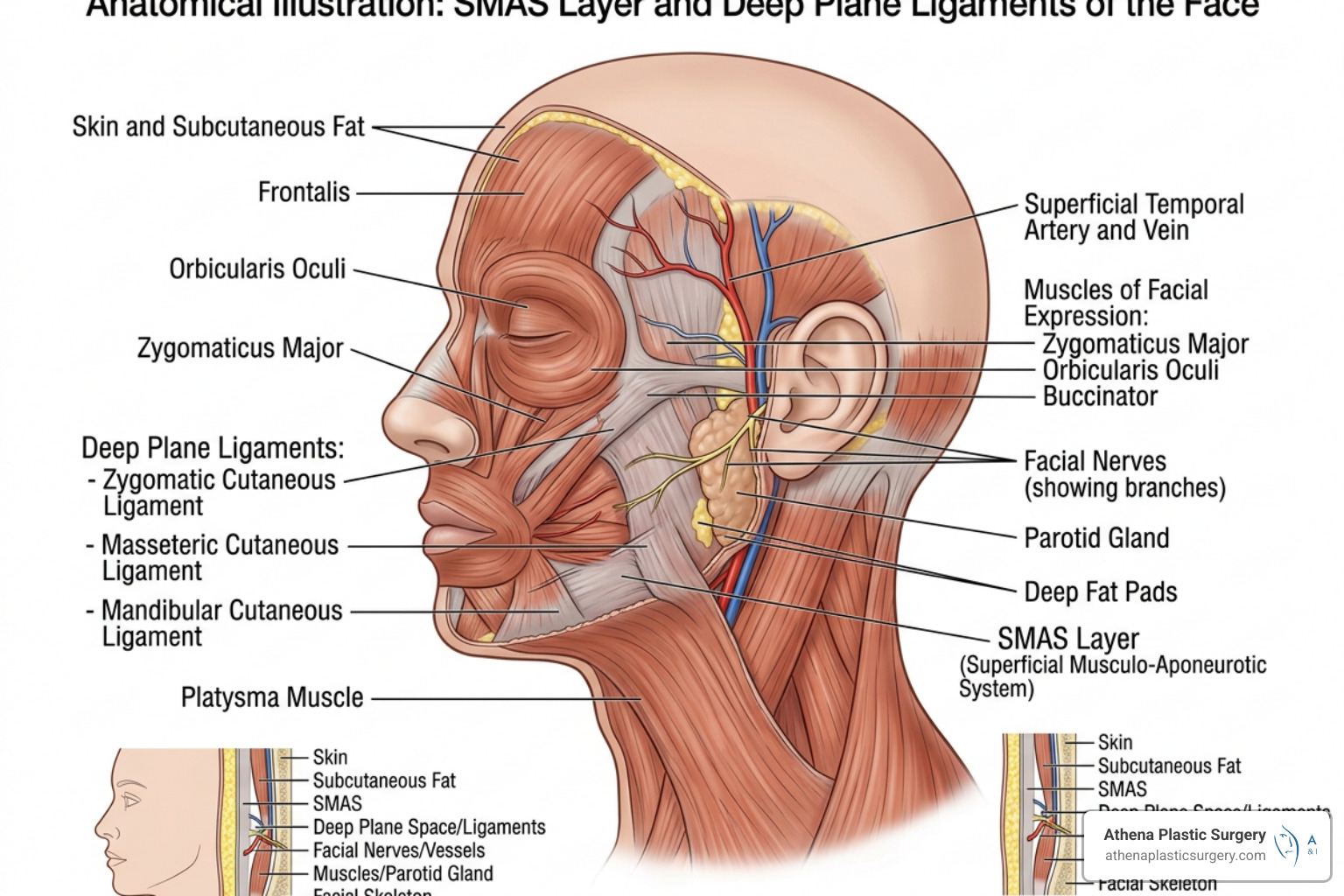
The “magic” of the deep plane approach lies in the dissection. During a deep plane facelift, we enter the space beneath the SMAS. This allows us to release the four main retaining ligaments of the face. Once these are free, the cheek fat pads and the underlying muscles can be lifted vertically. This is crucial because it avoids that “windswept” or “pulled” look that haunted facelifts of the 1980s. When the foundation is moved, the skin just lays naturally over the top.
In a mini facelift, the technique is often called an “S-lift” due to the shape of the incision. The incisions are smaller, usually hidden in the natural creases around the ear and hairline. While this means less scarring, it also limits how much tissue we can safely move.
Regardless of the technique, safety is our priority. Scientific research on preventing facelift complications highlights that while deep plane surgery is more complex due to its proximity to facial nerves, an experienced surgeon can navigate this space safely to provide superior results. We also take great care to ensure surgical scars are virtually invisible once healed.
Comparing Recovery and Downtime
Recovery is a major factor in the deep plane facelift vs mini facelift debate. We know you have busy lives in South Florida, and “social downtime” is a real consideration.
Mini Facelift Timeline:
- Days 1-3: Mild swelling and bruising; most patients manage with over-the-counter discomfort relief.
- Day 7: Sutures are usually removed. Most patients feel comfortable running errands (with a little concealer).
- Days 10-14: Return to work and light social activities.
Deep Plane Facelift Timeline:
- Days 1-5: Significant swelling and bruising. You’ll want to stay home and keep your head elevated.
- Week 2: Swelling begins to subside noticeably. Many patients return to work at the end of the second week.
- Month 1: You’ll look great in photos, though “micro-swelling” can persist for a few months.
One common side effect of the deeper dissection is temporary numbness. If you’re curious about the healing process, you can read about how long numbness lasts after a deep plane facelift and find more recovery timelines on our site.
Safety Profiles and Potential Risks
Every surgery has risks, but we work tirelessly to minimize them. In a deep plane facelift, the primary risk involves the facial nerves, as we are working in the same “plane” where they reside. However, because we move the tissue as a single unit, there is actually less trauma to the small blood vessels in the skin compared to traditional lifts, which can actually lead to better skin healing.
Mini facelifts carry lower risks of nerve injury but have a higher “risk” of patient dissatisfaction if the procedure was under-selected for the degree of aging present.
At Athena Plastic Surgery, we adhere to the highest American Society of Plastic Surgeons membership standards. This means we use board-certified anesthesiologists and operate in accredited facilities. For more tips on ensuring a smooth journey, see our facelift post-op tips.
Choosing the Right Procedure for Your Aesthetic Goals
Sometimes, a facelift alone isn’t the answer. We are seeing a rise in “Ozempic face”—a term for the facial volume loss that occurs after rapid weight loss using GLP-1 medications. In these cases, skin tightening isn’t enough; we need to restore volume.
We often combine a deep plane facelift vs mini facelift with:
- Fat Grafting: Using your own fat to “re-inflate” sunken cheeks or hollow temples.
- Neck Lift: While a deep plane lift addresses the neck, some patients require a separate facelift-neck lift combination to address “turkey gobbler” bands.
- Liquid Facelifts: For those not ready for surgery, Botox and fillers can bridge the gap, though they won’t provide the structural change of a surgical lift.
Investment and Costs
We understand that a facelift is a significant investment in your confidence. Pricing for these procedures is never “one size fits all.” It depends on several factors, including:
- The complexity of your specific anatomy.
- Whether we are combining the lift with other procedures (like eyelid surgery or fat transfer).
- Facility fees and anesthesia costs.
- The surgeon’s level of expertise and specialized training.
Because every face is unique, pricing varies depending on the doctor, practice, geographic location, and the specifics of the procedure. We encourage you to contact us directly or visit our page on mini face and neck lift cost for more information on how we structure our surgical plans. We believe in total transparency and will provide a detailed, personalized quote during your consultation.
Frequently Asked Questions
Is a mini facelift right for patients in their 30s?
While rare, it can be appropriate for patients in their late 30s who have experienced significant weight loss or have genetic predispositions to early jowling. However, for most 30-somethings, non-surgical treatments are often the first line of defense.
How do incision locations differ between the two?
A mini facelift typically uses an “S-shaped” incision that stops just behind the earlobe. A deep plane facelift incision usually extends further behind the ear and into the hairline to allow for the necessary redraping of the neck and midface skin.
Are the results of a deep plane facelift permanent?
In a sense, yes. You will always look younger than you would have without the surgery. However, no surgery can stop the biological process of aging. You will continue to age from your new, rejuvenated starting point.
Conclusion
The “debate” between deep plane facelift vs mini facelift isn’t about finding a winner—it’s about finding the right fit for you. Whether you need the subtle “pick-me-up” of a mini lift or the transformative, structural rejuvenation of a deep plane facelift, our goal at Athena Plastic Surgery is to provide results that look natural, refreshed, and undeniably “you.”
Dr. Avron and our compassionate team are dedicated to serving the Stuart and West Palm Beach communities with the highest standard of care. If you’re ready to see which technique will best help you reach your aesthetic goals, we invite you to schedule a consultation in West Palm Beach or Stuart today. Let’s start this journey together.




