


How many units of Botox for forehead? Flawless 2025
Understanding Botox Units for Your Forehead
How many units of Botox for forehead wrinkles is one of the most common questions we hear from patients considering this popular treatment. Here’s the quick answer:
Standard Forehead Botox Dosage:
- 10-30 units for horizontal forehead lines alone
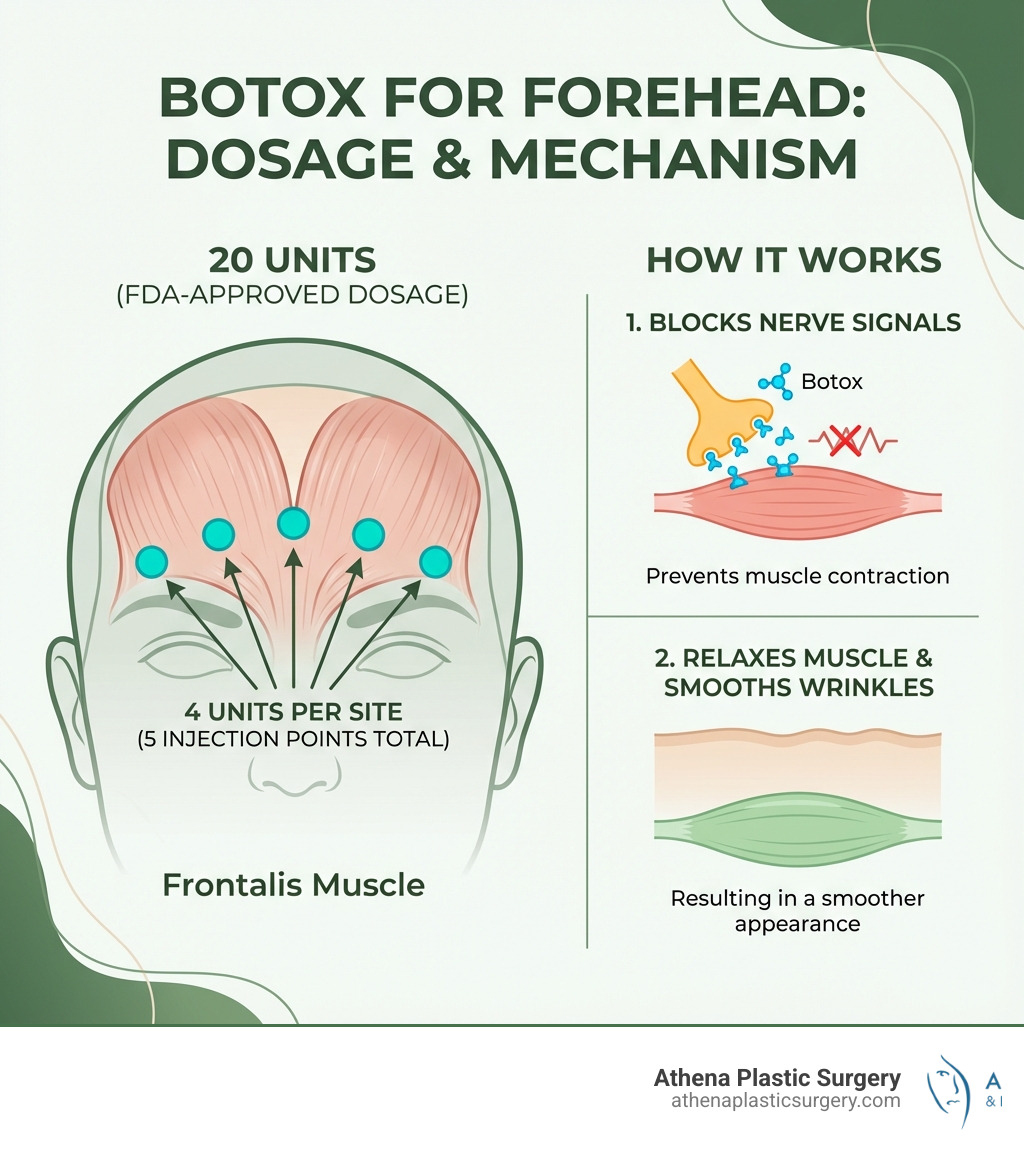
- 20 units is the FDA-approved dose (4 units per site across 5 injection points)
- 40 units total when treating forehead and frown lines together (20 units forehead + 20 units glabella)
- First-time patients often start with 10-20 units for natural-looking results
The exact number varies based on your muscle strength, wrinkle depth, forehead size, and aesthetic goals.
If you’ve noticed those horizontal lines across your forehead becoming more prominent when you raise your eyebrows, you’re not alone. These dynamic wrinkles develop from repeated muscle movements over time, and Botox works by temporarily relaxing the frontalis muscle that creates them.
Botox (onabotulinumtoxinA) is an FDA-approved neurotoxin that blocks nerve signals to muscles, preventing the contractions that cause wrinkles. When injected into the forehead, it smooths existing lines and prevents deeper ones from forming. Results typically last 3-4 months, making it a popular maintenance treatment for those seeking a refreshed, natural appearance.
I’m Dr. Avron Lipschitz, a Board-Certified Plastic Surgeon with over 15 years of experience performing thousands of cosmetic procedures, including determining optimal Botox dosages for how many units of Botox for forehead treatments custom to each patient’s unique facial anatomy. My training at Johns Hopkins Hospital and aesthetic fellowship in Manhattan has equipped me to deliver natural-looking results that improve your confidence.
How many units of Botox for forehead? further reading:
- how many units of botox for 11 lines
- how many units of botox for jaw
- how many units of botox for lip flip
How Many Units of Botox for Forehead Wrinkles? The Official Guidelines
When we talk about how many units of Botox for forehead wrinkles, understand the official guidelines and recommendations. These are based on extensive research and clinical trials to ensure both safety and efficacy. Our goal at Athena Plastic Surgery is always to achieve a refreshed, natural-looking result that improves your unique beauty.
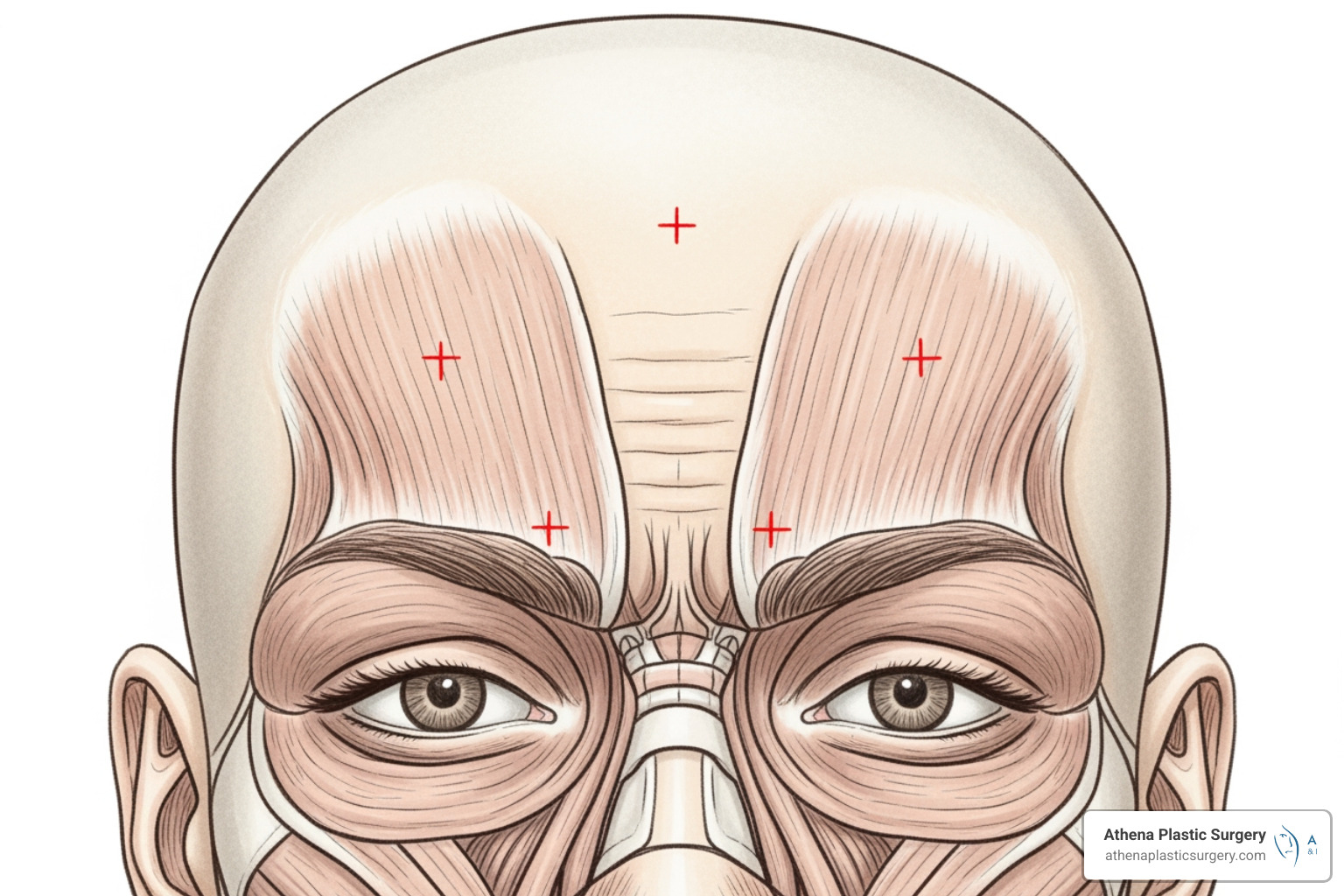
The forehead is primarily treated for horizontal lines, which are caused by the frontalis muscle lifting the eyebrows. Botox works by relaxing this muscle, smoothing out these “worry lines.”
The Manufacturer’s Recommendation
For horizontal forehead lines, the manufacturer of Botox Cosmetic, Allergan, suggests a specific dosage. Their recommendation is to administer 4 units into each of five specific sites on the forehead, totaling 20 units for the forehead area. This approach helps to effectively relax the frontalis muscle and reduce the appearance of lines.
This precise method of injecting 4 units per site across 5 injection points is designed to achieve muscle relaxation while maintaining a natural look and preventing potential side effects like brow heaviness. Our expert injectors are carefully trained in this technique, ensuring careful placement for optimal results.
Why Forehead and Frown Lines are Often Treated Together
You might notice that often, the forehead (horizontal lines) and the area between the eyebrows (glabellar lines, also known as “11 lines”) are treated simultaneously. This is because these areas are part of what we call the “upper face” and the muscles here work in conjunction. The glabellar complex involves muscles (like the corrugator and procerus) that pull the brows down and together, while the frontalis muscle lifts the brows.
Treating both areas together helps to create a harmonious and balanced result. If only the forehead is treated, and the frown lines remain active, it can sometimes lead to an unnatural appearance or even a compensatory overactivity in the untreated muscles. By addressing both the brow depressors and brow elevators, we can achieve natural-looking results that avoid a “frozen” or surprised look. When treated in conjunction with glabellar lines, the total recommended dose for both areas can be 40 units (20 units for the forehead and 20 units for the glabellar lines).
For more detailed information on treating the lines between your eyebrows, explore our guide on More info about Botox for 11 lines.
Key Factors That Determine Your Ideal Botox Dosage
While there are general guidelines for how many units of Botox for forehead treatments, the truth is, everyone is unique! The ideal number of units for you will depend on a variety of personal factors. This is why a personalized consultation with a qualified expert is so crucial. At Athena Plastic Surgery, we believe that understanding these factors is key to achieving the beautiful and natural-looking results you desire.
The effectiveness and longevity of your Botox treatment are influenced by:
- Muscle Strength: Stronger muscles require more units to achieve relaxation.
- Wrinkle Depth: Deeper, more established wrinkles may need more units or a combination of treatments.
- Skin Quality: Your skin’s elasticity and overall condition play a role.
- Metabolism: How quickly your body metabolizes the product can affect how long results last.
- Aesthetic Goals: Do you want complete stillness, or a softer, more natural look with some movement?
Understanding these elements helps us tailor a treatment plan specifically for you, maximizing the Benefits of Botox.
How many units of Botox for forehead based on personal factors?
Let’s dive deeper into how your individual characteristics influence the number of units needed for your forehead:
- Muscle Activity and Strength: Some individuals naturally have more expressive faces or stronger frontalis muscles due to genetics or repetitive movements over time. Stronger muscles require more Botox units to achieve the desired level of relaxation. During your consultation, we’ll assess your muscle activity by asking you to make various facial expressions.
- Forehead Size: A larger forehead area may necessitate more injection sites and a higher total unit count to ensure even distribution and comprehensive treatment of all horizontal lines.
- Static vs. Dynamic Lines: Botox primarily targets dynamic wrinkles—those that appear when you make facial expressions. If you have very deep lines that are present even when your face is at rest (static lines), while Botox can soften them, they may also benefit from a combination approach with other treatments like dermal fillers.
- Desired Outcome: We’ll discuss your aesthetic goals. Do you prefer a completely smooth forehead with minimal movement, or a more subtle approach often referred to as “Baby Botox,” which uses fewer units to soften lines while retaining some natural expression? Many first-time Botox recipients start with a lower dosage of 10 to 20 units to achieve natural-looking results. For those with more severe forehead lines, up to 50 units or more may be required.
- Preventative Treatment: Younger patients, even those in their late 20s or 30s, might opt for Botox as a preventative measure. By relaxing the muscles before deep lines fully form, we can help delay the onset of more pronounced wrinkles.
Are Botox Dosages Different for Men and Women?
Yes, generally, there are differences in Botox dosages for men and women, particularly for the forehead and glabella. Men typically have stronger, larger facial muscles and thicker skin compared to women. This higher muscle mass and strength often means that men require more Botox units to achieve similar results.
For instance, while a woman might need 10-30 units for horizontal forehead lines, a man might require a higher number. Research indicates that for glabellar lines (frown lines), higher doses are often needed in male patients. This personalized approach ensures that we account for anatomical differences to deliver effective and aesthetically pleasing outcomes for all our patients.
You can dig deeper into this topic through specific Research on higher doses for men.
How Forehead Units Compare to Other Treatment Areas
To give you a clearer picture, here’s a comparison of typical Botox unit ranges for different facial areas. These are general ranges, and your specific needs will be determined during your consultation.
| Area | Typical Botox Units |
|---|---|
| Forehead Lines | 10-30 units |
| Glabellar Lines (“11s”) | 20-40 units |
| Crow’s Feet | 5-15 units per side (10-30 total) |
| Masseter (Jaw) | 15-30 units per side |
| Lip Flip | 4-6 units |
| Neck | 30-50 units |
While Botox is a fantastic solution for many areas, there are other neurotoxins available, such as Dysport or Xeomin, which may have different unit equivalencies. To understand how these compare, you might find our article on Botox vs Dysport helpful.
Your Botox Journey: From Consultation to Lasting Results
Starting on your Botox journey at Athena Plastic Surgery is a guided, personalized experience. From your initial consultation to understanding the longevity of your results, we prioritize your comfort, safety, and satisfaction.

Your journey begins with a thorough initial consultation where we discuss your aesthetic goals, assess your facial anatomy, and review your medical history. This allows us to craft a customized treatment plan custom specifically to you. We’ll outline the recommended number of units, the expected results, and provide all the necessary information for your post-treatment care. For a comprehensive overview, check out What you need to know about Botox.
What to Expect During Your Treatment
Botox injections are a quick and straightforward procedure. Here’s what you can typically expect:
- Preparation: We’ll cleanse the treatment area thoroughly. While often not necessary, a topical numbing cream or ice may be applied to improve your comfort, though most patients find the injections to be very tolerable.
- Injections: Using a very fine needle, our expert injector will administer tiny amounts of Botox into the targeted muscles of your forehead. The entire injection process usually takes only 10-15 minutes. Many patients describe the sensation as a small pinch or pinprick.
- No Downtime: One of the greatest advantages of Botox is that there’s typically no downtime. You can resume most of your normal activities immediately after your appointment. We’ll provide specific aftercare instructions, such as avoiding lying down, vigorous exercise, or rubbing the injection sites for a few hours.
Understanding the Results and Longevity
The magic of Botox doesn’t happen instantly, but it’s certainly worth the short wait!
- Initial Results: You may begin to notice subtle changes within 24-48 hours after your treatment.
- Full Effect: The full smoothing effect typically becomes visible within 10-14 days. We often schedule a follow-up visit around this time to assess your results and make any minor adjustments if needed.
- Duration of Results: For most patients, Botox results on the forehead last approximately 3 to 4 months. Factors like your metabolism, muscle activity, and the number of units injected can influence this duration.
- Maintenance Treatments: To maintain your refreshed look, we recommend scheduling regular follow-up treatments every 3-4 months. Many patients find that with consistent treatments, the effects may even begin to last longer, sometimes extending up to 4-6 months, as the muscles become accustomed to being relaxed.
Potential Side Effects and Risks of Forehead Botox
Botox is a widely used and generally safe treatment when administered by a qualified professional. However, like any medical procedure, there are potential side effects and risks to be aware of:
Common, Mild Side Effects:
- Temporary bruising or swelling at the injection sites.
- Mild headache, which usually subsides within a few hours (reported in about 9% of clinical trials for forehead lines).
- Redness or tenderness in the treated area.
Less Common, but More Significant Risks (often associated with improper injection technique or excessive units):
- Brow Ptosis (Drooping): This is a temporary drooping of the eyebrow, which can occur if Botox spreads to muscles that support the eyelid. It’s a rare side effect, reported in about 2% of clinical trials for forehead lines, and usually resolves as the Botox wears off.
- Asymmetry: Uneven relaxation of muscles can lead to a lopsided appearance.
- “Frozen” Look: While some patients prefer minimal movement, an overly “frozen” or expressionless look can occur with too many units or improper placement.
- Allergic Reactions: Though rare, severe allergic reactions are possible.
To minimize these risks, it is paramount to choose an experienced, board-certified injector who possesses a deep understanding of facial anatomy and proper injection techniques. We always adhere to the highest safety standards at Athena Plastic Surgery. For comprehensive details on safety, you can refer to the Official BOTOX safety information.
Frequently Asked Questions about Forehead Botox
We understand you likely have many questions about how many units of Botox for forehead treatments. Here are some of the most common inquiries we receive at Athena Plastic Surgery:
How much does forehead Botox cost?
Pricing for Botox injections for the forehead can vary widely depending on several factors, including the number of units required, the expertise of your injector, and your geographic location. Because each treatment plan is highly individualized, we encourage you to schedule a personalized consultation with us to get an accurate, custom estimate for your specific needs. Rest assured, we offer transparent pricing and will discuss all costs upfront during your visit to our West Palm Beach or Stuart locations. To learn more about our services in your area, visit Botox West Palm Beach.
Who is the best candidate for forehead Botox?
Ideal candidates for forehead Botox are generally adults over 18 who are bothered by dynamic wrinkles (lines that appear with facial expressions) on their forehead. They should be in good overall health and have realistic expectations about the results.
Botox is a fantastic option for:
- Individuals with visible horizontal forehead lines or deep frown lines.
- Those looking to prevent deeper wrinkles from forming.
- People seeking a refreshed, more youthful appearance without surgery.
However, certain individuals should avoid Botox. These contraindications include:
- Pregnant or breastfeeding women.
- Individuals with certain neurological conditions or neuromuscular disorders (e.g., Myasthenia Gravis, Lambert-Eaton Syndrome).
- Those with an infection at the proposed injection site.
- Individuals with known allergies to any components of Botox.
Our team will conduct a thorough medical history review during your consultation to ensure Botox is a safe and appropriate treatment for you. For more information on eligibility, visit Is Botox Right For Me?.
How many units of Botox for forehead lines for the first time?
If it’s your first time getting Botox for your forehead, we typically recommend a conservative approach. Many first-time Botox recipients start with a lower dosage, often in the range of 10 to 20 units, to achieve natural-looking results.
This allows us to assess how your muscles respond to the treatment. We usually schedule a follow-up appointment about two weeks after your initial injections. At this visit, we can evaluate the results and, if necessary, administer a few additional “touch-up” units to fine-tune the outcome. This gradual approach helps ensure you achieve a refreshed look without over-treatment, making your Trying Botox for the first time experience positive and custom to your preferences.
Finding a Qualified Injector for Your Forehead Botox
Choosing the right practitioner is perhaps the most critical step in your Botox journey. The skill, experience, and artistic eye of your injector directly impact the safety and quality of your results.
At Athena Plastic Surgery, Dr. Avron Lipschitz is a Johns Hopkins-trained, Board-Certified Plastic Surgeon with experience in facial aesthetics. When seeking an injector for your forehead Botox, look for these qualifications:
- Board-Certified Plastic Surgeon or Dermatologist: These specialists have undergone rigorous training and possess in-depth knowledge of facial anatomy, which is crucial for precise and safe injections.
- Experienced Nurse Injector: Many practices also employ highly trained and certified nurse injectors who work under the supervision of a physician. Ensure they have specialized training and extensive experience with Botox.
- Anatomical Knowledge: A qualified injector understands the complex network of facial muscles and nerves, knowing exactly where to inject to achieve desired results and avoid complications.
- Consultation Quality: A good injector will take the time to listen to your goals, assess your unique facial structure, and explain the treatment plan, including potential risks and benefits.
Never compromise on qualifications for a lower price. Your face is too important!
Achieve Your Smoothest Forehead with Expert Care
Understanding how many units of Botox for forehead wrinkles is just the first step. Achieving a beautifully smooth and natural-looking forehead requires a personalized approach, expert knowledge, and a commitment to safety. At Athena Plastic Surgery, led by Dr. Avron Lipschitz, we combine our deep understanding of facial anatomy with an artistic eye to deliver results that improve your confidence and reflect your natural beauty.
We invite you to experience the difference that expert care can make. Schedule a consultation with us today to discuss your aesthetic goals and find your personalized Botox treatment plan. Let us help you achieve your smoothest forehead yet!




