


Is a Surgical or Non-Surgical Facelift Right for You?
Surgical vs non-surgical facelift — this is one of the most common questions people face when they start noticing sagging skin, deepening wrinkles, or a loss of definition in their jawline.
Here’s a quick answer:
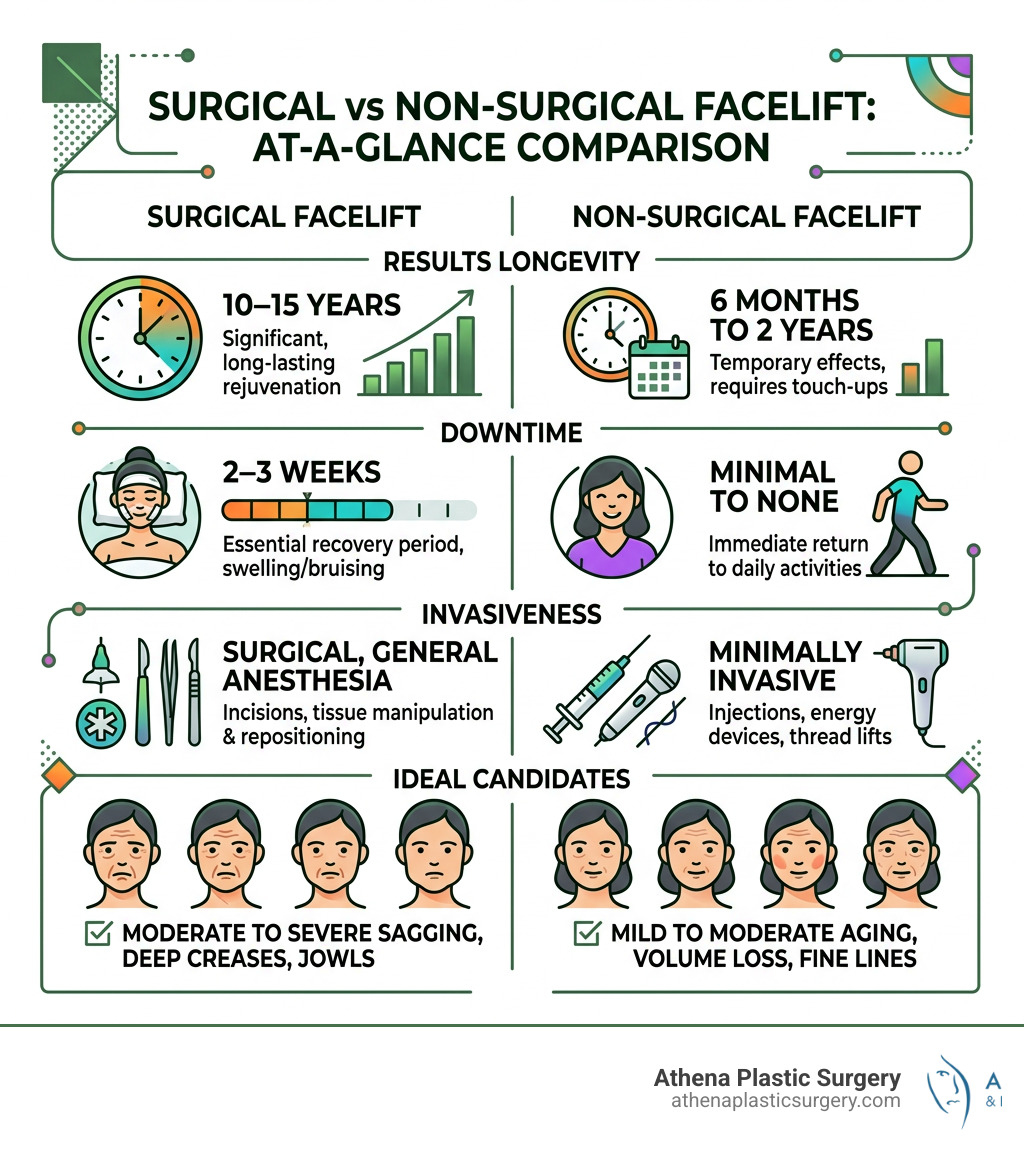
| Surgical Facelift | Non-Surgical Facelift | |
|---|---|---|
| Best for | Moderate to severe sagging, deep creases, jowls | Mild to moderate aging, volume loss, fine lines |
| Results last | 10–15 years | 6 months to 2 years |
| Downtime | 2–3 weeks | Minimal to none |
| Invasiveness | Surgical, general anesthesia | Injections, energy devices, threads |
| Cost | Higher upfront, lower long-term | Lower upfront, higher long-term |
| Structural change | Yes — repositions deep tissue and muscle | No — surface-level volume and tightening only |
Aging affects everyone differently. Some people in their mid-40s may only need a little volume restored in the cheeks. Others may have significant skin laxity that no injectable can fully correct. The right choice depends entirely on your specific concerns, goals, and lifestyle.
This guide breaks down both options clearly — so you can walk into a consultation already knowing the right questions to ask.
I’m Dr. Avron Lipschitz, MD, a board-certified plastic surgeon with over 15 years of experience performing advanced cosmetic procedures, including the full spectrum of surgical vs non-surgical facelift options. Trained at Johns Hopkins Hospital and Manhattan Eye and Ear Hospital alongside world-renowned cosmetic surgeons, I’ve helped thousands of patients find the right path to natural, lasting facial rejuvenation.
Understanding the Surgical Facelift (Rhytidectomy)
When we talk about a surgical facelift, technically known as a facelift-rhytidectomy, we are looking at the gold standard for facial rejuvenation. Unlike surface-level treatments, a surgical facelift addresses the root causes of visible aging: gravity and structural laxity.
As we age, it isn’t just our skin that droops; the underlying framework of the face shifts. The most critical component in modern surgery is the SMAS layer (Superficial Musculoaponeurotic System). This is a layer of tissue deep beneath the skin that connects your facial muscles. In a traditional or deep-plane-facelift, we don’t just “pull the skin tight”—which can lead to that dreaded “wind-tunnel” look. Instead, we physically lift and reposition this SMAS layer to a more youthful, vertical position.
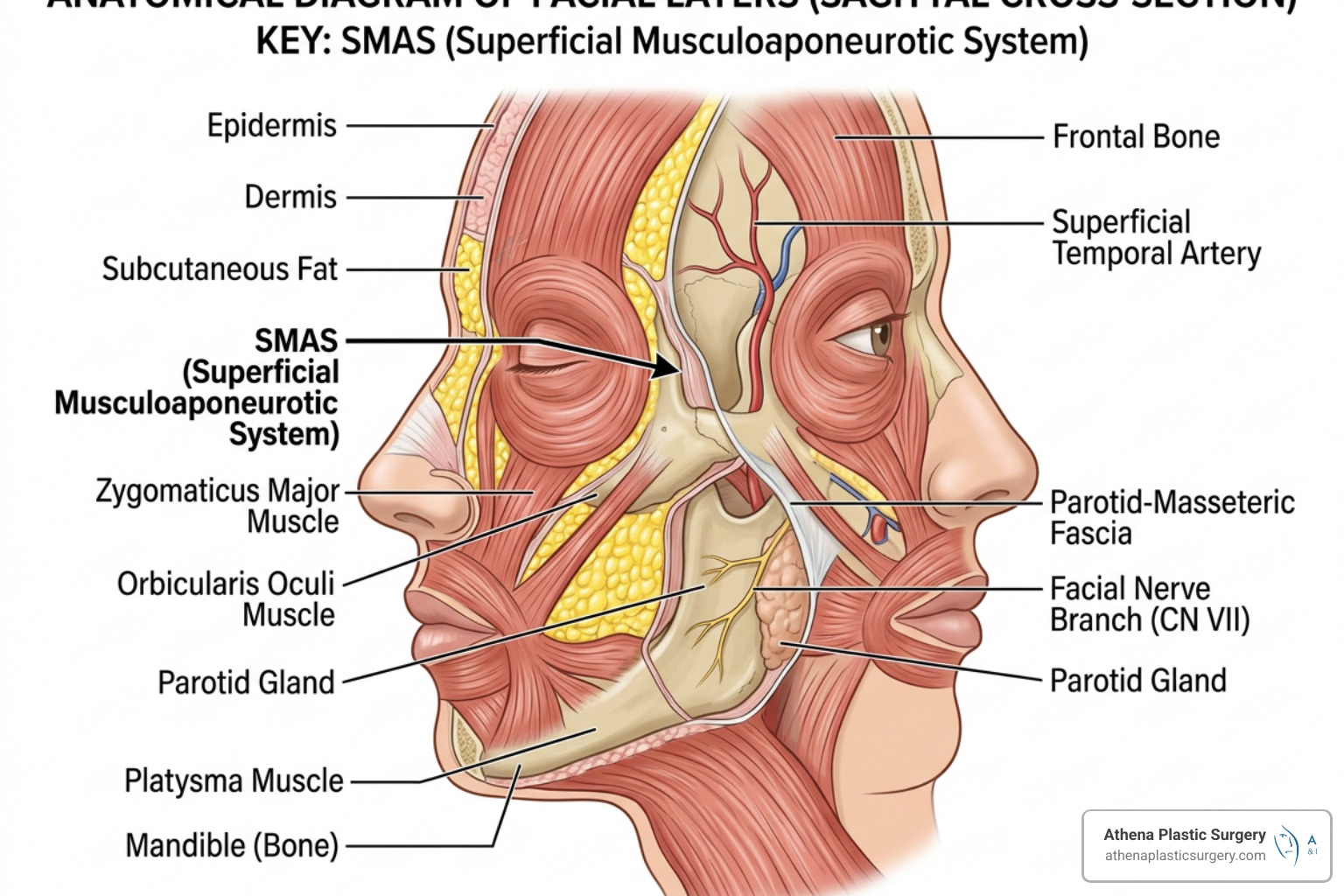
The deep-plane-facelift-complete-guide highlights how this technique allows for a more natural tension-free closure. Once the internal structures are secured, any excess, sagging skin is carefully trimmed away. This procedure is typically performed under general anesthesia, ensuring you are completely comfortable throughout the process. By targeting the mid-face, jowls, and jawline, surgery provides a comprehensive transformation that non-surgical methods simply cannot replicate for patients with significant skin laxity.
Exploring Non-Surgical Facelift Options
For those who aren’t ready for the operating room or only have mild signs of aging, non-surgical-facial-rejuvenation offers a versatile toolkit. These treatments focus on two main things: restoring lost volume and improving skin texture.
One of the most popular choices is the “liquid facelift.” But what-is-a-liquid-facelift? It is a customized combination of dermal fillers (like Juvéderm or Restylane) and neuromodulators (like Botox). Fillers “plump” areas that have hollowed out, such as the cheeks or temples, while Botox relaxes the muscles that cause forehead lines and crow’s feet.
Other innovative options include:
- PDO Thread Lifts (V Lift™): These involve placing absorbable threads under the skin to physically lift the tissue. While the threads eventually dissolve, they stimulate your body to produce new collagen, providing a subtle “boost” for 1 to 2 years.
- Laser Resurfacing & RF Microneedling: These energy-based treatments target the skin’s surface and deeper dermis to trigger a healing response, tightening the skin and smoothing out fine lines.
According to the Cleveland Clinic, the primary liquid-facelift benefits include minimal downtime and immediate results. However, it is important to remember that these treatments do not remove excess skin or reposition deep muscles.
Surgical vs Non-Surgical Facelift: Key Differences in Results and Longevity
The biggest divide in the surgical vs non-surgical facelift debate is how long the “new you” lasts. Surgery is an investment in your future self; non-surgical treatments are more like a high-end maintenance plan.
| Feature | Surgical Facelift | Non-Surgical Options |
|---|---|---|
| Primary Goal | Structural repositioning & skin removal | Volume restoration & surface tightening |
| Result Longevity | 10–15 years (Traditional), 5–10 years (Mini) | 6–18 months (Fillers/Botox), 1–2 years (Threads) |
| Procedure Time | 3–5 hours | 30–60 minutes |
| Incision Type | Discreetly hidden around the ears/hairline | Needle pricks or small punctures |
Research from the American Society of Plastic Surgeons suggests that while non-surgical results can be impressive, they are temporary. If you opt for injectables, you will likely need touch-ups every 6 to 12 months to maintain the effect. Over a decade, the cost and time of these maintenance visits can actually exceed the one-time cost of surgery.
Furthermore, there are 5-types-of-facelifts, ranging from the “Mini” (ideal for early jowls) to the “Deep Plane” (for comprehensive rejuvenation). Each offers a level of durability that non-surgical options simply cannot match because they physically alter the anatomy rather than just camouflaging the signs of aging.
Recovery, Risks, and Considerations for Each Path
We often tell our patients in Stuart and West Palm Beach: “You have to trade a little time for a lot of years.”
Surgical Recovery:
A traditional facelift requires patience. You can expect 2 to 3 weeks of significant downtime. During the first week, bruising and swelling are common. Most patients feel “restaurant ready”—meaning they can go out in public without feeling self-conscious—by the 14-day mark. However, subtle internal healing continues for several months. If you are looking for a shorter window, you might explore what-is-a-mini-face-lift, which often requires only 5 to 7 days away from work.
Non-Surgical Recovery:
This is the “lunchtime” option. Most patients return to their normal activities immediately. You might experience some mild swelling or a tiny bruise at the injection site, but this usually resolves in 3 to 5 days.
Risks:
Every procedure carries some risk. Surgical risks include anesthesia complications, hematoma (blood collection), or scarring. However, when performed by a board-certified surgeon, these are rare. Non-surgical risks are generally lower but can include asymmetry, “over-filled” appearances, or, in very rare cases with fillers, vascular issues. This is why the facelift-vs-neck-lift-what-are-the-differences conversation is so important—sometimes people try to “fix” a neck problem with facial fillers, which only leads to an unnatural look.
How to Choose the Right Approach for Your Aging Concerns
Determining if you need a surgical vs non-surgical facelift
So, how do you decide? It usually comes down to the “Pinch Test” and your specific anatomy.
- Choose Non-Surgical if: You are primarily concerned with “hollow” eyes, thin lips, or fine surface wrinkles. If you can still see your jawline but want to look more “rested,” injectables are likely your best first step.
- Choose Surgical if: You have “jowls” (sagging skin along the jaw), a “turkey neck,” or deep folds running from your nose to your mouth (nasolabial folds). If you can pinch an inch or more of loose skin along your jawline, a non-surgical treatment will likely leave you disappointed.
If you are unsure where you fall on this spectrum, the ASPS surgeon referral service is a great tool to find qualified experts who can give you an honest assessment.
Combining treatments for a surgical vs non-surgical facelift effect
The best results often don’t come from just one procedure; they come from a “multimodal” approach. For example, a surgical facelift tightens the structure, but it doesn’t fix “sun-damaged” skin. We often combine surgery with laser resurfacing to improve the skin’s “glow” or fat transfer to restore youthful volume.
Additionally, many patients find that face-neck-lift-can-they-be-done-together is the most efficient route. By addressing the face and neck simultaneously, we ensure the entire profile looks harmonious. There’s nothing that “gives away” a facelift faster than a tight face paired with a sagging neck!
Frequently Asked Questions
How long do the results of each procedure last?
A surgical facelift typically lasts 10 to 15 years. This doesn’t mean you “expire” after a decade; it means that while you will continue to age naturally, you will always look about 10 years younger than you would have without the surgery. Non-surgical results vary: Botox lasts 3–4 months, fillers last 6–18 months, and thread lifts last 1–2 years.
What is the cost difference between these options?
Pricing for surgical vs non-surgical facelift procedures varies significantly based on the complexity of your case, the specific techniques used, and the geographic location of the practice. Surgery has a higher upfront cost because it involves operating room fees, anesthesia, and the surgeon’s specialized expertise. Non-surgical options are much more affordable per session, but because they require regular maintenance, the long-term investment can eventually catch up to the cost of a single surgery. We encourage you to contact our office directly for a personalized quote based on your unique goals.
Who is the ideal candidate for a liquid facelift?
The ideal candidate for a liquid-facelift is typically someone in their late 30s to early 50s with mild to moderate volume loss but still-good skin elasticity. It is perfect for the patient who says, “I just look tired,” rather than “I have too much skin.” If you want to “test the waters” before committing to surgery, this is a fantastic “preview” option.
Conclusion
Choosing between a surgical vs non-surgical facelift is a deeply personal decision. At Athena Plastic Surgery, we believe that education is the first step toward confidence. Whether you are looking for the dramatic, decade-defying results of a deep-plane-facelift-vs-facelift comparison or the subtle refreshment of a liquid lift, our goal is to ensure you look like the best version of yourself.
Dr. Avron and our compassionate team in Stuart and West Palm Beach are dedicated to aesthetic excellence. We don’t believe in “one-size-fits-all” beauty. We take the time to listen to your concerns, evaluate your anatomy, and create a personalized plan that fits your lifestyle and your budget.
Ready to see what’s possible? Schedule a consultation for facial rejuvenation today and let us help you turn back the clock with grace and precision.