


Your Eyes Deserve to Look as Awake as You Feel
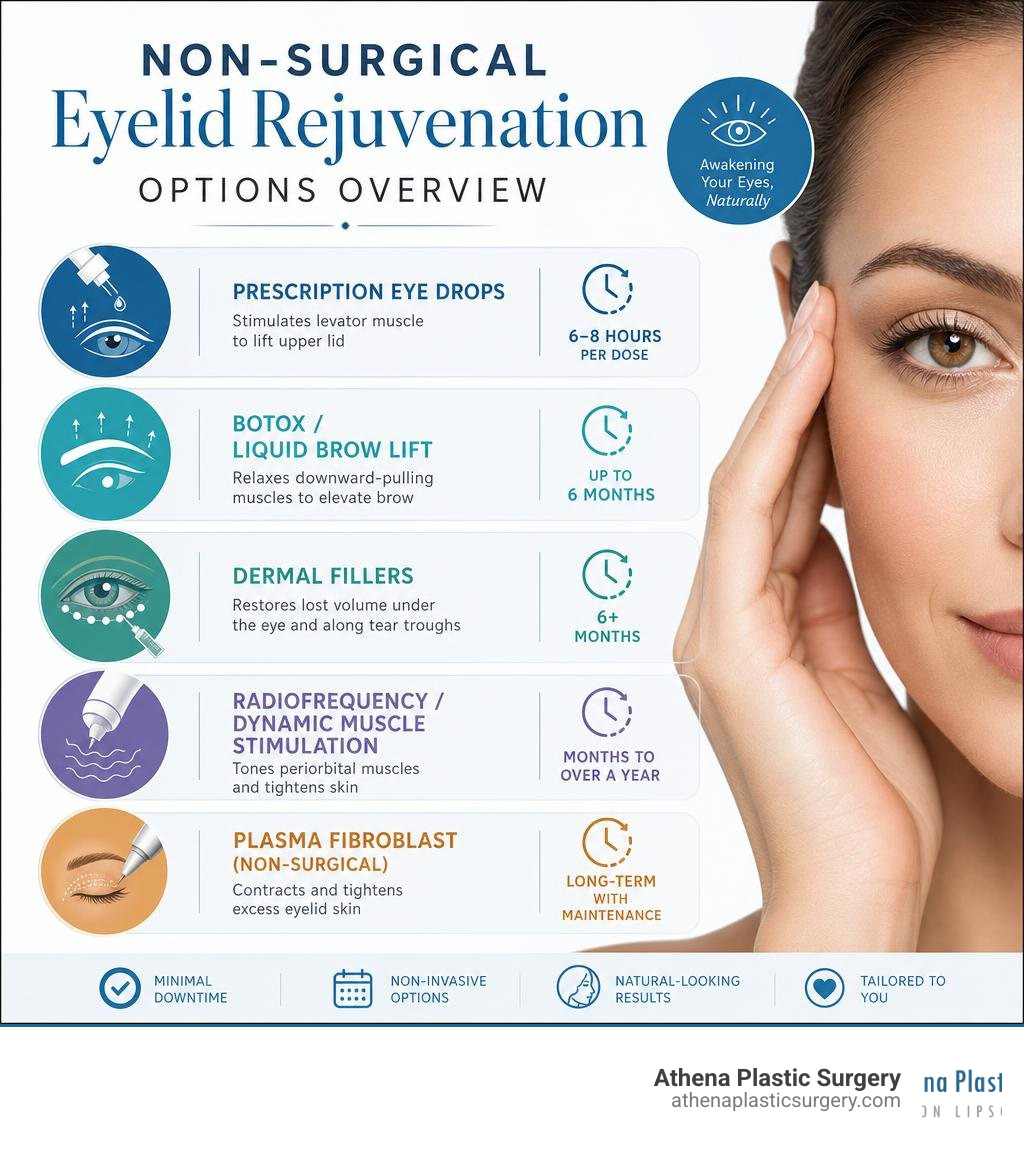
If you’re exploring an eyelid lift without surgery, here are the most effective non-surgical options available today:
| Treatment | How It Works | Results Last |
|---|---|---|
| Prescription eye drops (Upneeq) | Stimulates levator muscle to lift upper lid | 6–8 hours per dose |
| Botox / liquid brow lift | Relaxes downward-pulling muscles to elevate brow | Up to 6 months |
| Dermal fillers | Restores lost volume under the eye and along tear troughs | 6+ months |
| Radiofrequency / Dynamic Muscle Stimulation | Tones periorbital muscles and tightens skin | Months to over a year |
| Plasma fibroblast (e.g., Plexr) | Contracts and tightens excess eyelid skin | Long-term with maintenance |
It often starts with something small. Your eyeliner creases differently. Your eyes look tired even after a full night of sleep. You look in the mirror and see heaviness where there used to be openness.
You’re not imagining it.
The skin around your eyes is the thinnest on your entire face. It loses elasticity faster than anywhere else. Over time, the muscles that hold your eyelids up weaken, fat shifts, and skin begins to sag. For many people, this happens gradually through their 40s and 50s — right when they least want to look as tired as life sometimes feels.
The good news? Surgery isn’t your only option anymore.
Over the past decade, a range of non-surgical treatments has emerged — from the first FDA-approved prescription eye drop for droopy eyelids to energy-based devices that tone the muscles around your eyes. These treatments won’t replace surgery for everyone, but for the right candidate, they can deliver real, visible results with little to no downtime.
I’m Dr. Avron Lipschitz, MD, a Board-Certified Plastic Surgeon with over 15 years of experience helping patients achieve natural-looking results — including through non-surgical approaches to an eyelid lift without surgery. In this guide, I’ll walk you through every meaningful option so you can make an informed decision about what’s right for you.
Easy eyelid lift without surgery glossary:
Understanding Droopy Eyelids: Causes and Symptoms
To understand how an eyelid lift without surgery works, we first need to look at what causes our eyes to look heavy or tired in the first place. There are two primary culprits behind drooping eyes:
- Acquired Ptosis (Low-Lying Eyelids): This occurs when the levator muscle—the main muscle responsible for keeping your upper eyelid open—stretches, weakens, or separates. This is incredibly common as we age. In fact, humans naturally lose 3% to 8% of their skeletal muscle mass every decade after the age of 30, and the delicate muscles around the eyes are no exception.
- Dermatochalasis (Excess Skin Laxity): This is the physical sagging of the skin itself. Because the skin around the eyes has fewer oil glands and collagen fibers, it loses structural integrity quickly. This creates a “hooded” appearance, where excess skin literally drapes over the natural crease of the eye.
Beyond the cosmetic impact, droopy eyelids can have functional consequences. When eyelids lose their natural tension and sag, it can lead to incomplete blinking. Statistics show that lower lid laxity affects 78.3% of patients who visit ophthalmology clinics for eyelid-related concerns, and more than 60% of dry eye patients struggle with impaired lid closure. When you can’t blink fully, your eyes dry out, leading to chronic irritation and a tired, heavy sensation.
Understanding the root cause of your drooping is essential because it dictates which non-surgical treatment will work for you. For instance, a treatment that tones the muscle won’t completely erase a heavy fold of excess skin, while a skin-tightening laser won’t fix a weakened levator muscle.
More tips on improving drooping eyelids can help you identify exactly what is happening with your eye anatomy.
Top Non-Surgical Eyelid Rejuvenation Treatments

If you are not ready for a surgical blepharoplasty, we offer several advanced, non-invasive options designed to tighten skin, tone underlying muscles, and restore lost volume.
Explore surgical vs non-surgical eyelid options to see how these modern techniques stack up against classic procedures.
Prescription Eye Drops: A Quick Eyelid Lift Without Surgery
For patients experiencing mild to moderate acquired ptosis, prescription eye drops have completely changed the game. The most famous of these is Upneeq (oxymetazoline hydrochloride ophthalmic solution, 0.1%).
Upneeq is the first and only FDA-approved prescription eye drop designed to treat acquired blepharoptosis (low-lying eyelids) in adults. It works by targeting the levator palpebrae muscle (specifically a portion called Müller’s muscle). When you apply the drop, the active ingredient causes this muscle to contract, instantly lifting the upper eyelid by approximately 1 to 2 millimeters.
It is an incredibly simple, once-daily solution that acts like a temporary, non-surgical lift. For many patients, it is the perfect “secret weapon” to wake up their eyes before a major meeting, a social event, or just to get through a long workday without feeling heavy-eyed.
Energy-Based Skin Tightening and Muscle Toning
When the issue is a combination of loose skin and weakened periorbital muscles, we turn to advanced energy-based devices.
Dynamic Muscle Stimulation (DMSt) & Radiofrequency (RF): Devices like OptiLIFT by Lumenis combine these two powerful modalities into a single treatment. Think of DMSt as a targeted “barre class” for your eyelids. It sends gentle electrical impulses to activate and tone the delicate muscles around the eyes, restoring their natural tightness. Simultaneously, RF energy heats the deeper layers of the skin to stimulate fresh collagen production.
The clinical results of this combination are outstanding. A breakthrough study showed that patients experienced at least a 75% reduction in lower lid laxity, a 70% improvement in blinking quality, and a massive 286% improvement in tear breakup time (which directly relieves dry eye symptoms). You can read more about this technology here: How OptiLIFT Transforms Lower Lid Laxity Treatment | Lumenis and explore the device specifications via OptiLIFT – Lumenis.
- Plasma Fibroblast (Plexr): Often referred to as “plasma blepharoplasty,” this treatment uses a controlled plasma arc to sublimate (vaporize) microscopic points on the surface of the skin. This causes the skin to immediately contract and tighten. A single Plexr treatment can deliver up to 30% of the planned surgical-like result, making it an exceptional option for treating hooded upper eyelids and crepey skin without incisions.
Injectables, Dermal Fillers, and Liquid Brow Lifts
Sometimes, the appearance of a droopy eyelid is actually caused by a descending eyebrow or a loss of volume in the surrounding facial structures.
- The Liquid Brow Lift (Botox): By strategically injecting neuromodulators like Botox into the muscles that pull the eyebrow downward (such as the orbicularis oculi and corrugator muscles), we allow the upward-pulling forehead muscles to lift the brow unrestricted. This creates a subtle, beautiful arch that opens up the upper eyelid space.
- Tear Trough Fillers: Under-eye hollows and dark circles can cast shadows that make the lower eyelids look saggy and tired. Using hyaluronic acid dermal fillers, we can restore youthful volume, smoothing the transition between the lower lid and the cheek.
To understand how injectables compare to surgical correction, read The Ultimate Showdown Between Eyelid Surgery and Tear Trough Fillers.
Choosing an Eyelid Lift Without Surgery vs. Surgical Blepharoplasty
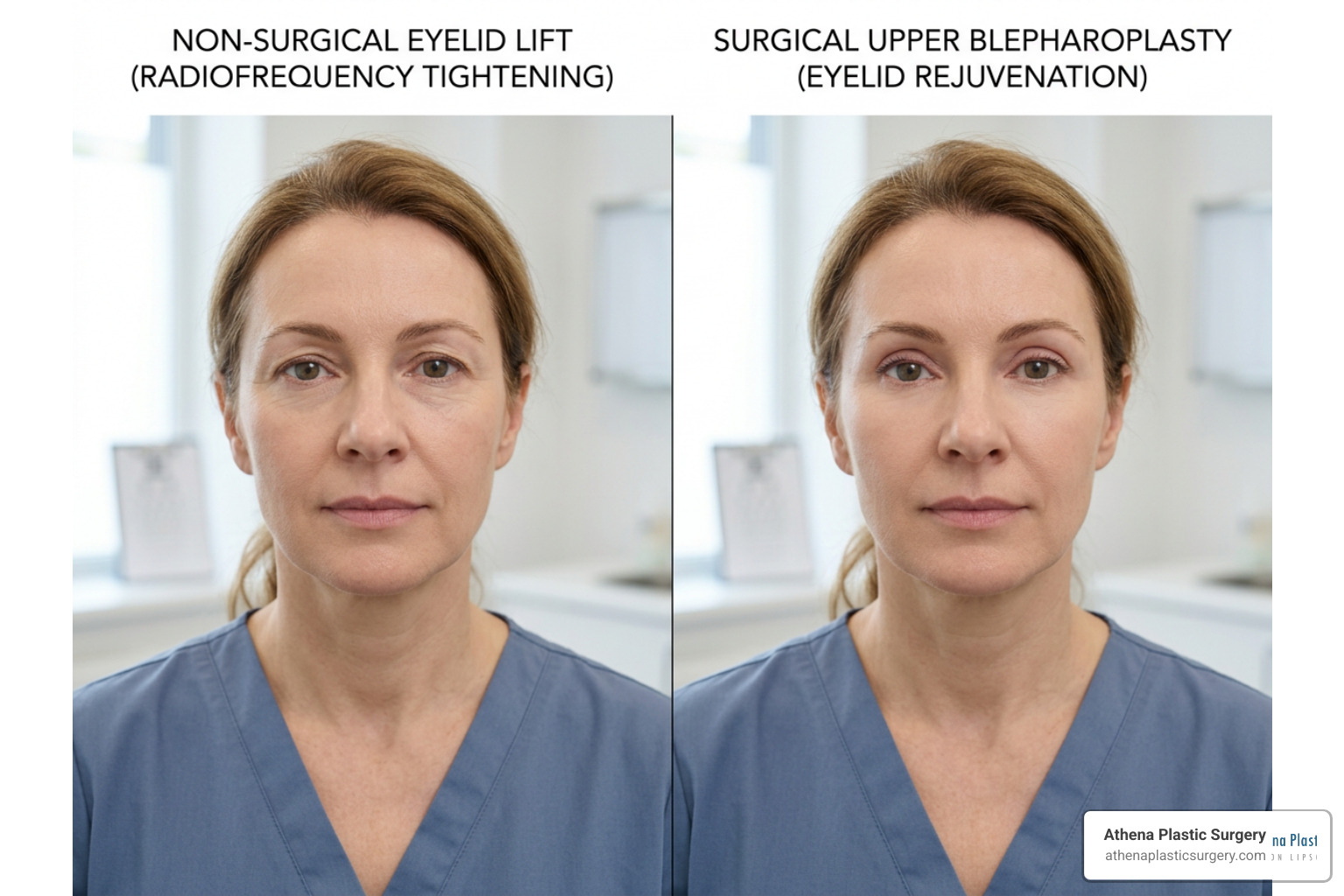
While non-surgical options are highly effective for early-to-moderate signs of aging, they have physical limitations. Traditional surgical blepharoplasty remains the gold standard for dramatic, permanent rejuvenation because it physically removes excess skin and repositions displaced fat pads.
| Feature | Non-Surgical Eyelid Lift | Surgical Blepharoplasty |
|---|---|---|
| Primary Goal | Tighten skin, tone muscles, or temporarily lift lids | Remove excess skin/fat, structurally reshape lids |
| Downtime | None to 1 week (depending on treatment) | 1 to 2 weeks |
| Anesthesia | None or topical numbing | Local anesthesia with sedation or general |
| Longevity | Temporary (hours to a year; requires maintenance) | Long-lasting (typically 10 to 20 years) |
| Best For | Mild-to-moderate laxity, volume loss, early aging | Severe sagging, heavy hooding, structural bags |
Who is the Ideal Candidate for an Eyelid Lift Without Surgery?
You are likely an excellent candidate for a non-surgical approach if you:
- Have mild-to-moderate skin laxity or early hooding around the eyes.
- Experience mild acquired ptosis (which can be corrected with drops like Upneeq).
- Want to avoid incisions, stitches, or general anesthesia.
- Have realistic expectations and understand that results are subtle and require ongoing maintenance.
- Do not have severe, vision-impairing skin sagging or complex neurological ptosis.
Benefits and Limitations of Non-Surgical Approaches
The benefits of going non-surgical are clear: treatments are performed quickly in-office, carry a much lower risk profile, and require minimal to no downtime.
However, the limitations are equally important to note. Non-surgical treatments cannot correct severe hooding, they cannot remove herniated fat pads (the cause of stubborn under-eye “bags”), and their results are temporary. If you have significant skin draping over your eyelashes that impairs your field of vision, surgery is still the most effective and reliable path forward.
At-Home Care, Lifestyle Adjustments, and Recovery
While professional treatments do the heavy lifting, your daily habits play a massive role in maintaining your results and preventing further sagging. The skin around your eyes responds quickly to how you treat your body.
- Prioritize Sleep: Chronic sleep deprivation causes blood vessels under the eyes to dilate, leading to dark circles and fluid retention that stretches the delicate skin.
- Protect Against UV Damage: UV rays are the number one cause of premature collagen breakdown. Always wear a broad-spectrum SPF around the orbital rim and wear UV-blocking sunglasses when outdoors.
- Hydrate and Nourish: Drinking plenty of water keeps the skin plump, while a diet rich in antioxidants helps fight the free radicals that accelerate skin aging.
- Ditch the Tapes and Glues: Avoid using temporary double-eyelid tapes or glues. Over time, the constant stretching and chemical irritation from these adhesives can cause allergic contact dermatitis and actually accelerate skin stretching, making sagging worse.
Frequently Asked Questions About Non-Surgical Eyelid Lifts
How fast do prescription eye drops work and how long do they last?
Prescription drops like Upneeq are remarkably fast-acting. Most patients begin to see a visible lift in as little as 5 to 15 minutes after application. The maximum lifting effect is typically reached within 2 hours, and the results last anywhere from 6 to 8 hours. Because they are packaged in single-use sterile vials, they are easy to use once daily as part of your morning routine.
What is the recovery or downtime like for non-surgical eyelid treatments?
It depends entirely on the treatment:
- Upneeq and Fillers/Botox: Virtually zero downtime. You can return to work or normal activities immediately, though fillers may cause mild, temporary swelling or bruising for a few days.
- OptiLIFT (RF/DMSt): No downtime. You may experience mild redness immediately after the session, which resolves within a few hours.
- Plasma Fibroblast (Plexr): Requires about 5 to 7 days of recovery. The treatment leaves tiny, carbon crusts (micro-scabs) on the skin that must be kept clean and dry until they naturally flake off.
How much does a non-surgical eyelid lift cost?
Because “non-surgical eyelid lift” is a highly customized term, the overall cost varies depending on the specific combination of treatments you receive (such as eye drops, muscle stimulation, fillers, or plasma therapy), the geographic location of the practice, and your provider’s level of expertise.
To get an accurate estimate tailored to your unique facial anatomy and cosmetic goals, we encourage you to schedule a personalized consultation with us.
Learn more about eyelid surgery cost in Florida.
Conclusion
An eyelid lift without surgery is an incredible way to refresh your appearance, open up your eyes, and look as energetic as you feel—all without the need for a scalpel or significant downtime. Whether you are looking to lift low-lying lids with Upneeq, build muscle tone with OptiLIFT, or smooth out lines with injectables, there is a non-surgical path designed for you.
At Athena Plastic Surgery, led by Johns Hopkins-trained Dr. Avron Lipschitz, we specialize in both surgical and advanced non-surgical facial rejuvenation. We serve the Stuart and West Palm Beach, FL communities with a dedication to safety, natural-looking results, and compassionate care.
Ready to explore your options? Schedule your consultation for blepharoplasty and eyelid surgery or non-surgical rejuvenation with our expert team today.




