


Is Saline Implant Surgery Right for You?
Saline implant surgery is one of the most common breast enhancement procedures chosen by women today — but how does it compare to silicone, and is it the right fit for your goals?
Here’s a quick comparison to help you decide:
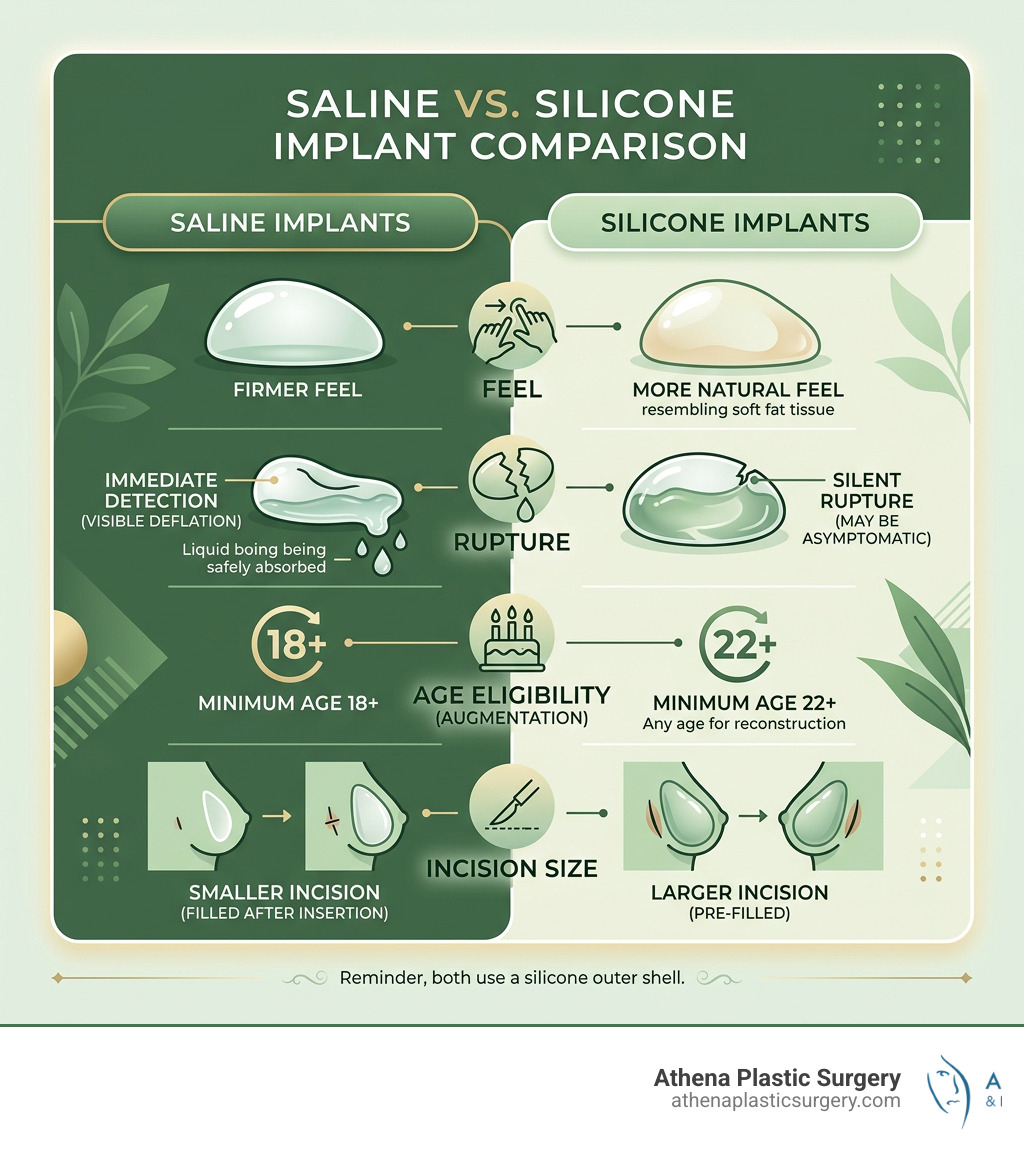
| Feature | Saline Implants | Silicone Implants |
|---|---|---|
| Filling | Sterile saltwater | Cohesive silicone gel |
| Minimum age (augmentation) | 18+ | 22+ |
| Feel | Firmer | More natural |
| Rupture detection | Immediate (visible deflation) | May be silent |
| If it leaks | Saline absorbed safely by body | Gel may stay in pocket |
| Incision size | Smaller (filled after insertion) | Larger (pre-filled) |
| Reconstruction | Any age | Any age |
Both types use a silicone outer shell. The key difference is what’s inside — and that affects everything from how they feel to how a rupture shows up.
Saline implants are inserted empty, then filled with sterile saltwater once in place. This allows for smaller incisions and the ability to fine-tune volume during surgery for better symmetry. If a saline implant ruptures, the saltwater is harmlessly absorbed by the body — though surgery is still needed to remove and replace the shell.
This guide walks you through everything you need to know: how the procedure works, what recovery looks like, the risks involved, and how saline compares to silicone across the board.
I’m Dr. Avron Lipschitz, MD, a board-certified plastic surgeon with over 15 years of experience performing advanced aesthetic procedures — including saline implant surgery — with training from Johns Hopkins Hospital and Manhattan Eye and Ear Hospital. My goal is to help you make a confident, informed decision that aligns with your body, your lifestyle, and your aesthetic goals.
Understanding Saline Breast Implants vs. Silicone
When we sit down with patients at our Stuart or West Palm Beach offices, the first question is almost always: “What’s the real difference?” At its core, every breast implant features a durable silicone elastomer shell. The distinction lies entirely in the filler material.
Saline implants are filled with a sterile saltwater solution. Because they are filled after they are placed inside the breast pocket, they offer a unique level of intraoperative flexibility. In contrast, silicone implants are pre-filled with a cohesive gel that mimics the texture of natural fat. When choosing between breast-implant-choices-silicone-saline, many of our patients appreciate the “peace of mind” that comes with saline. If a leak occurs, the body simply absorbs the saltwater, and the change is immediately visible as the breast deflates.
Silicone implants are often praised for a more natural feel, especially in patients with very little natural breast tissue. However, they require more intensive monitoring because a rupture can be “silent,” meaning the gel stays within the scar tissue capsule and isn’t obvious without imaging. According to the FDA’s guide on Types of Breast Implants, saline remains a gold standard for those who prioritize safety and easy detection.
| Characteristic | Saline Implants | Silicone Implants |
|---|---|---|
| FDA Approval Age | 18 for augmentation | 22 for augmentation |
| Shell Material | Silicone Elastomer | Silicone Elastomer |
| Filling | Sterile Saline (Saltwater) | Cohesive Silicone Gel |
| Detection of Leak | Obvious (Deflation) | Requires MRI or Ultrasound |
| Incision Length | Typically 1 inch or less | Typically 2 inches or more |
Eligibility and Age Restrictions
Safety regulations are strict when it comes to age. For cosmetic breast augmentation, the FDA requires patients to be at least 18 years old for saline implants. If you are interested in silicone gel implants for augmentation, the age requirement jumps to 22.
However, these age limits do not apply to reconstructive surgery. Women of any age undergoing reconstruction after a mastectomy, trauma, or due to a congenital birth defect are eligible for both saline and silicone options. Determining if you are a good-candidate-breast-augmentation involves more than just age; we also look for good physical health and realistic expectations about the outcome.
Primary Uses: Augmentation vs. Reconstruction
While most people think of saline implant surgery as a way to increase cup size, its applications are diverse:
- Augmentation: This is the most common use. It focuses on enhancing the volume and shape of the breasts to improve body proportions or restore volume lost after pregnancy or weight loss.
- Reconstruction: For patients in our Stuart community recovering from breast cancer, saline implants are a vital part of the healing journey. Often, we use tissue expanders first to gradually stretch the skin before placing the permanent implant.
- Symmetry Correction: No two breasts are perfectly identical. Saline is excellent for correcting breast-augmentation concerns where one breast is significantly smaller or shaped differently than the other, as we can fill the implants to different levels to achieve balance.
The Saline Implant Surgery Procedure and Techniques
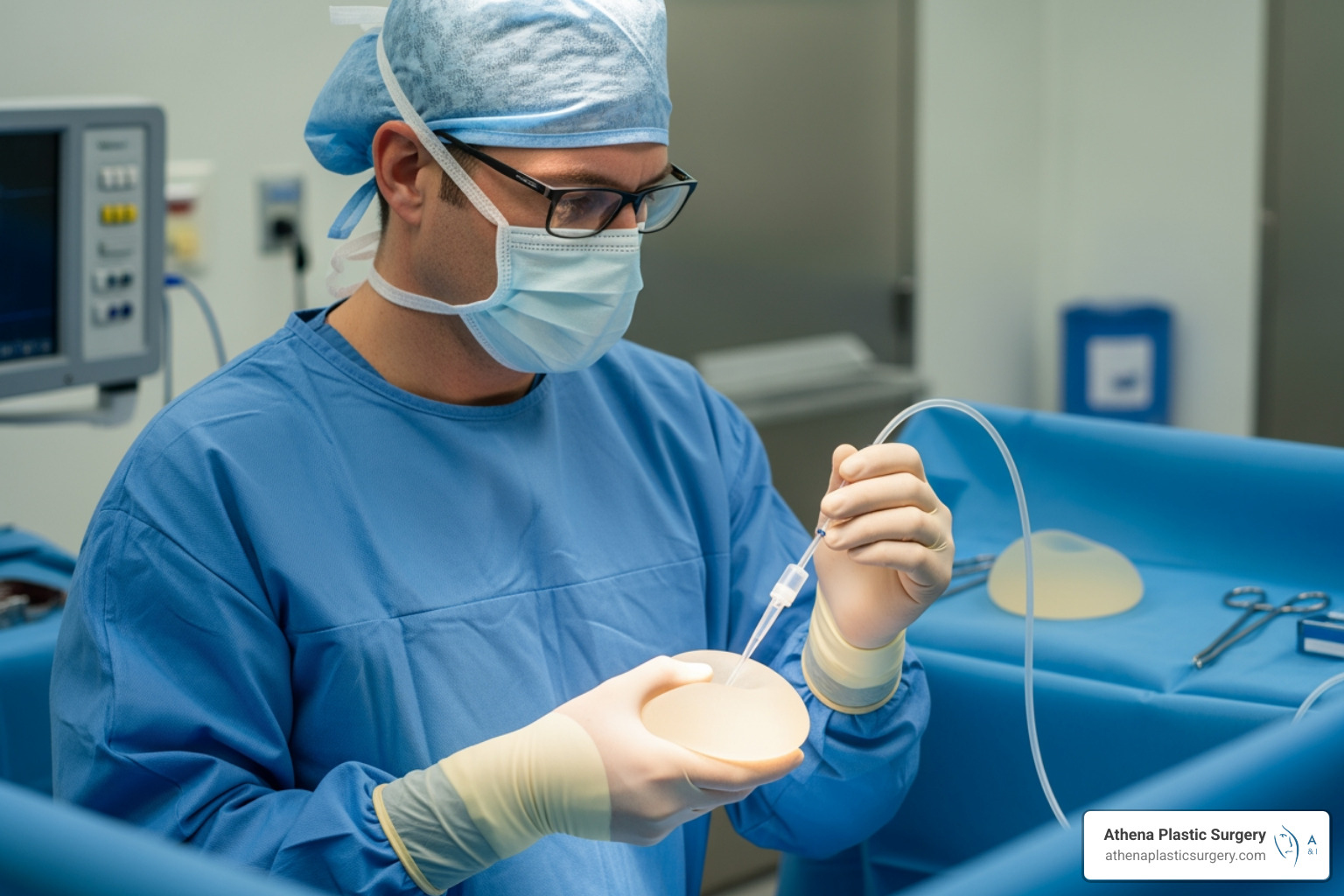
We perform saline implant surgery as an outpatient procedure, typically under general anesthesia. The surgery itself usually takes between one and two hours. One of the greatest technical advantages of saline-breast-implants is that they are rolled up like a tiny cigar and inserted through a very small incision. Once inside the “pocket” we’ve created, we use a fill tube to pump in the sterile saline until we reach the perfect volume.
Knowing what-to-expect-with-a-breast-augmentation-surgery helps ease pre-op jitters. You’ll arrive at the surgical center, meet with our team, and wake up in recovery wearing a supportive surgical bra.
Common Incision Sites
Where the scar goes is a major consideration. Because saline implants are empty during insertion, we have more flexibility with incision locations:
- Inframammary Fold: The most common site, hidden in the crease under the breast.
- Periareolar: An incision made along the bottom edge of the nipple (areola).
- Transaxillary: Placed in the armpit, leaving no scar on the breast itself.
- Transumbilical (TUBA): An incision in the belly button through which the implant is tunneled up to the breast. While popular for avoiding breast scars, it is less common today as it offers the surgeon less control over the final placement.
If you are searching for breast-implants-near-me in West Palm Beach, we will discuss which site offers the best balance of concealment and surgical precision for your anatomy.
Placement Options for Saline Implants
The “pocket” for the implant can be created in two main areas:
- Submuscular (Under the Muscle): The implant is placed beneath the pectoral chest muscle. This provides more tissue coverage, which is vital for saline implants to prevent “rippling” or “wrinkling” that can sometimes be seen through thin skin. It also makes mammograms easier to read.
- Subglandular (Over the Muscle): The implant sits directly behind the breast tissue. Recovery is often faster and less painful, but the edges of the implant might be more palpable.
- Dual Plane: This is a hybrid approach we often favor, where the top of the implant is under the muscle and the bottom is covered by breast tissue, providing a natural slope.
Being a suitable-breast-augmentation-candidate often depends on how much natural tissue you have to cover the device.
Benefits and Risks of Saline Implants
The primary benefit of saline is the safety profile of the filler. If the shell breaks, you are essentially leaking Gatorade-strength saltwater into your body—totally harmless. Additionally, the ability to adjust the volume during surgery allows us to achieve high levels of symmetry.
However, no surgery is without risk. Scientific research on long-term outcomes shows that while satisfaction is high (over 90% in many studies), complications can occur. Common reasons-why-you-might-need-breast-implant-revision include:
- Capsular Contracture: This happens when the scar tissue around the implant becomes unusually tight and hard.
- Deflation: A leak in the valve or shell causing the implant to flatten.
- Rippling: Visible folds or waves in the implant, more common with saline than silicone.
- BIA-ALCL: A rare type of lymphoma associated with textured implant shells. We predominantly use smooth shells to minimize this risk.
Managing Rupture and Deflation
If you wake up one morning and notice one breast looks significantly smaller than the other, don’t panic! It is likely a saline deflation. Because the saline is absorbed, there is no emergency health risk. However, you will need a surgical procedure to remove the empty silicone shell. During this time, most patients choose to have a new implant inserted. While we can’t give a flat rate for breast-implant-revision-cost without a consultation, we work with our patients to make the replacement process as smooth as possible.
Safety and Long-Term Monitoring
The FDA recommends that all patients with implants perform monthly breast self-exams. You should feel for any new lumps, hard areas, or changes in shape. Saline implants are “self-monitoring” in many ways because a rupture is so obvious.
When it comes to imaging, our breast-implant-types-complete-guide emphasizes the importance of telling your mammography technician that you have implants. They will use “displacement views” to ensure they get a clear look at your natural breast tissue. For more technical details, the Mayo Clinic’s overview on Breast implants: Saline vs. silicone provides excellent additional reading on long-term safety.
Recovery and Life After Surgery
Recovery from saline implant surgery is a journey of “dropping and fluffing.” Immediately after surgery, the implants sit high on the chest and may feel tight. Over the next few weeks, the muscles relax, and the implants settle into a more natural position.
- Days 1-3: Most patients feel some soreness, similar to a very intense chest workout.
- Week 1: You can usually return to a desk job. You’ll be in a supportive bra 24/7.
- Week 4-6: You can typically resume strenuous exercise and heavy lifting.
We dive deep into the breast-augmentation-recovery timeline during your pre-op appointments. Many women also have 5-common-concerns-considering-breast-augmentation, such as breastfeeding. Generally, breast implants do not prevent you from breastfeeding, though the incision type (like periareolar) can sometimes affect milk production more than others.
Frequently Asked Questions about Saline Implant Surgery
How much does saline implant surgery cost?
The total investment for your procedure includes the surgeon’s fee, anesthesia, surgical facility fees, and the cost of the implants themselves. Saline implants are generally less expensive than silicone gel implants, often by several hundred dollars.
Note: Pricing for saline implant surgery varies depending on the doctor, practice, geographic location, and the specifics of the procedure. Please contact Athena Plastic Surgery directly for accurate, personalized pricing information. We also offer various breast-implants-financing-options to help make your aesthetic goals a reality.
Is saline implant surgery right for me?
This depends on your body type and goals. If you have a breast-augmentation-small-bust, you might need submuscular placement to hide the edges of a saline implant. If you prefer a firmer feel or want the smallest possible incision, saline is likely your winner. The best way to know is to choose-surgeon-breast-augmentation experts who can show you physical samples of both types.
How long do saline implants last?
Breast implants are not lifetime devices. While some last 20 years or more, the average lifespan is often cited between 10 and 15 years. The risk of deflation increases by about 1% each year. We don’t necessarily recommend “proactive” replacement if the implants look and feel great, but you should be financially and mentally prepared for a future surgery. You can find more about the longevity of different devices in our guide to breast-implant-prices.
Conclusion
At Athena Plastic Surgery, we believe that every woman deserves to feel confident and comfortable in her own skin. Whether you are visiting us from Stuart or West Palm Beach, Dr. Avron Lipschitz and our compassionate team are here to guide you through every step of your saline implant surgery.
Choosing the right implant is a personal decision that balances safety, feel, and aesthetic goals. We invite you to Schedule a consultation to discuss your breast implant choices and discover how we can help you achieve the look you’ve always wanted with the care and expertise you deserve.




