


The Real Difference Between a Facelift and Fillers After 50
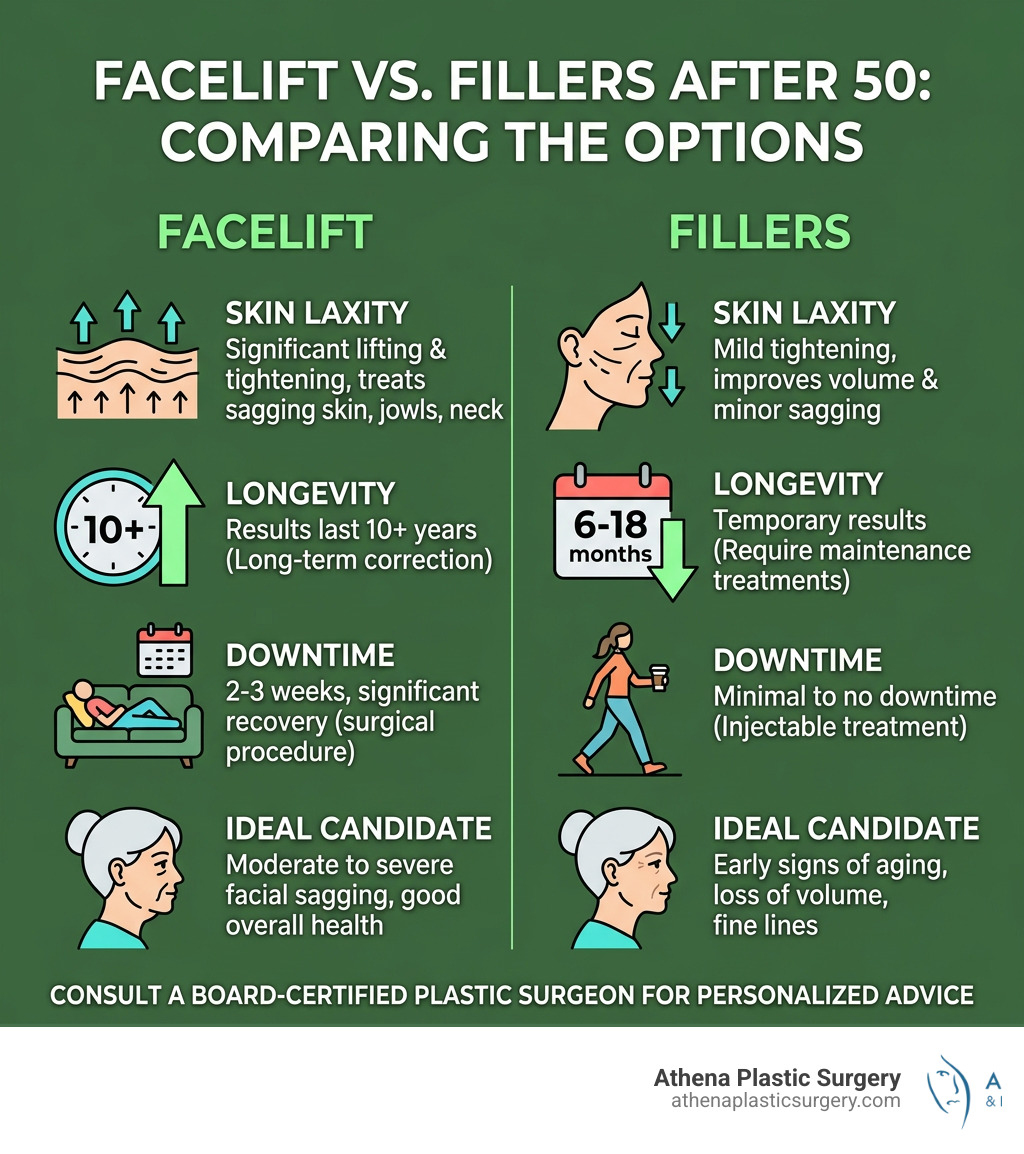
Is it better to get a facelift or fillers after 50? For most women with noticeable sagging, jowls, or a changing jawline, a facelift delivers more dramatic and longer-lasting results — but fillers can still play a valuable role for volume loss and fine lines, or as part of a combined approach.
Quick answer:
| Your Main Concern | Better Option |
|---|---|
| Mild volume loss, fine lines | Fillers |
| Sagging skin, jowls, loose neck | Facelift |
| Both volume loss and sagging | Facelift + fillers combined |
| Want zero downtime | Fillers |
| Want results that last 10+ years | Facelift |
The signs tend to creep up gradually. One day you notice deeper lines around your mouth. Then your jawline softens. Then you catch your reflection and think — when did that happen?
You’re not alone. Women over 50 now account for nearly 59% of all face, neck, and forehead lifts performed each year, and facelift procedures rose 8% from 2022 to 2023. The question isn’t whether to do something — it’s what to do.
Fillers are appealing. They’re quick, require no surgery, and show results immediately. But for women past 50, the real issue is often more than just lost volume. Skin loses its elasticity. The deeper structural layers — muscle, fat, and bone — all shift with age. Fillers can address some of this, but they can’t lift what gravity has already pulled down.
That’s where the decision gets more nuanced — and more personal.
I’m Dr. Avron Lipschitz MD, a board-certified plastic surgeon with over 15 years of experience performing advanced facial rejuvenation procedures, including facelifts, and I’ve guided countless patients through the exact question of is it better to get a facelift or fillers after 50. In this guide, I’ll walk you through the key differences so you can make a confident, informed choice.

Is it Better to Get a Facelift or Fillers After 50?
When we reach our 50s, the face undergoes a biological “changing of the guard.” In our 30s and 40s, we mostly deal with volume loss—the “deflation” of the cheeks and under-eyes. Dermal fillers are champions here; they act like spackle for a wall, filling in the dents. However, after 50, the primary concern usually shifts from deflation to descent.
Gravity, combined with a significant drop in collagen and elastin production, causes the facial tissues to migrate downward. This is where the debate of is it better to get a facelift or fillers after 50 becomes critical. If you try to treat significant sagging with fillers alone, you run the risk of the “overfilled” look. Because fillers add volume but cannot remove excess skin, using them to “lift” jowls often results in a face that looks wider or puffier rather than younger.

Dermal filler injections are excellent for smoothing nasolabial folds or plumping lips, but they lack the structural integrity to fight a sagging jawline. Surgery, on the other hand, addresses the root cause: the displacement of the underlying facial muscles and the redundancy of the skin.
Addressing Severe Skin Laxity and Jowls
By age 50, the Superficial Musculoaponeurotic System (SMAS)—the layer of tissue deep beneath your skin—begins to stretch and sag. This is what creates jowls. A face-lift-surgery/ at Athena Plastic Surgery doesn’t just pull the skin tight; we actually reposition that SMAS layer to its original, youthful position.
When patients ask about jowl-lift-cost/, they are often looking for a way to restore that crisp, clean line from the chin to the ear. Fillers can camouflage jowls by filling in the “pre-jowl sulcus” (the dip in front of the jowl), but eventually, the jowl becomes too heavy for camouflage to work. Surgery is the only way to physically remove the “heavy” look of the lower face.
Restoring the Youthful “V-Shape”
A youthful face is shaped like an inverted triangle or a “V”—wide at the cheekbones and narrow at the chin. Aging flips this triangle, making the face look square or “bottom-heavy.”
To restore the V-shape, we often look at the relationship between the face and the neck. Many of our patients over 50 find that a facelift-vs-necklift/ conversation is necessary because the neck often shows age faster than the face. By combining these approaches, we can achieve facelift-surgery-look-younger-with-tighter-skin/ results that look cohesive. You don’t want a 40-year-old face sitting on a 60-year-old neck!
Longevity and the “Filler Fatigue” Phenomenon
There is a growing trend in the aesthetic world known as “filler fatigue.” This happens when patients have been getting dermal-fillers/ for a decade or more. Because fillers are temporary, patients return every 6 to 12 months for “top-offs.” Over time, the filler can migrate or build up, leading to a loss of natural facial contours.
Furthermore, as we age, our metabolic rate and the way our tissues hold onto hyaluronic acid change. What worked in your 40s might require twice as much product in your 50s to achieve the same result. This “chasing of the tail” is a sign that it might be time to switch from a needle to a blade. You can learn more about this in our guide on how-long-do-dermal-fillers-last/.
Why a Facelift is Better to Get Than Fillers After 50 for Long-Term Results
The most compelling argument for surgery is its permanence. While nothing stops the clock entirely, a facelift turns back the clock about 10 years (and some studies suggest up to 12 years).
When you choose a surgical facelift-neck-lift/, you are investing in a structural repositioning that typically lasts a decade or more. For many of our Stuart and West Palm Beach patients, the peace of mind that comes with not needing a “refresh” every few months is priceless. Check out our insights on how-long-does-a-facelift-last/ for a deeper dive into the factors that influence surgical longevity.
Comparing Upfront Investment vs. Maintenance Costs
We understand that the average-cost-of-face-lift-surgery/ can seem daunting compared to a single syringe of filler. However, when you do the “50-and-over math,” the numbers tell a different story.
If a patient receives four syringes of filler every year at a cost of several thousand dollars, over ten years, they may spend significantly more than the cost of a single facelift. Surgery provides a “one-and-done” financial profile for the next decade, whereas fillers represent an escalating subscription service to your own face. While we don’t list specific prices here, we encourage you to schedule a consultation to get a quote tailored to your anatomy.
Modern Techniques: The Deep Plane Advantage
If your fear of a facelift is based on the “wind tunnel” or “pulled” looks of the 1990s, I have good news. Modern techniques, specifically the Deep Plane Facelift, have revolutionized the industry.
In a traditional facelift, the skin is pulled. In a deep-plane-facelift/, we go beneath the muscle layer to release the ligaments that hold the face in a “sagged” position. This allows us to move the entire facial unit as one, without putting tension on the skin. You can read our complete-guide/ to understand how-does-a-deep-plane-facelift-work/.
Avoiding the “Pulled” Look
The secret to a natural result after 50 is a vertical lift, not a horizontal pull. By releasing the deep ligaments, we can lift the cheeks and jawline straight back up to where they were in your 30s. This tension-free closure is also why deep-plane-facelift-scars/ are often virtually invisible; when there is no tension on the skin, the incisions heal beautifully.
This technique is especially beneficial for mature skin, which is thinner and more prone to showing the “stretched” signs of older surgical methods. Our goal is for your friends to ask if you’ve been on a long vacation or changed your hair—not who your surgeon was.
Deciding if it is Better to Get a Facelift or Fillers After 50 for Your Specific Goals
The choice ultimately comes down to your “aging profile.”
- The Volume Candidate: If you have great skin elasticity but hollow cheeks and temples, Juvederm/ or other fillers might be all you need.
- The Laxity Candidate: If you can “pinch and pull” more than an inch of skin at your jawline, fillers will likely disappoint you.
During a personalized consultation, we examine your skin quality, bone structure, and overall health to determine the right path. We also consider your lifestyle; some patients prefer the gradual change of fillers, while others want the “big reveal” of surgery.
Recovery, Risks, and Reality for the Mature Patient
Let’s talk about the “R” word: Recovery. This is the biggest hurdle for patients over 50. While fillers have almost zero downtime, a facelift is major-surgery/.
For a facelift, you should plan for about two weeks of “social downtime.” This doesn’t mean you’re in bed for 14 days; most of our patients are up and walking the next day. However, you will have swelling and bruising that you might not want to take to a board meeting or a wedding. You can find a detailed facelift-recovery-time/ timeline on our blog to help you plan.
Managing Post-Surgical Healing
We take recovery seriously at Athena Plastic Surgery. We provide a comprehensive facelift-recovery-tips-guide/ to every patient. This includes everything from how to sleep (elevated!) to which supplements to avoid.
What-to-expect-after-face-lift-surgery/ usually involves some tightness and numbness around the ears, which is normal and fades over time. By following our facelift-recovery-tips/, most patients find the process much easier than they anticipated.
The Role of Non-Surgical Maintenance
Choosing a facelift doesn’t mean you’re “done” with injectables forever. In fact, the best results often come from a combination. Surgery fixes the structure, but treating-facial-wrinkles-dermal-fillers/ can still address fine surface lines or lip thinning that a facelift doesn’t touch.
We often recommend restore-lost-facial-volume-with-injectable-treatments/ about six months after surgery to “polish” the results. Think of the facelift as the renovation of the house’s framing, and fillers as the interior decorating.
Frequently Asked Questions
When do fillers stop being effective for patients over 50?
Fillers stop being effective when the “weight” of the sagging skin exceeds the filler’s ability to provide lift. If you find yourself needing more and more syringes to see a difference, or if your face is starting to look wider rather than lifted, you have reached the limit of a liquid-facelift/. At this point, adding more filler only distorts your natural features.
How much downtime is required for a facelift compared to fillers?
Fillers: 0–24 hours (maybe some minor bruising).
Facelift: 10–14 days for “social” recovery (when you can go to the grocery store without a scarf), and 3–4 weeks for “event” recovery (weddings or photos). While a facelift is major-surgery/, modern anesthesia and surgical techniques have made the process much smoother than in decades past.
Can I combine a facelift with fillers for better results?
Absolutely. This is actually our preferred method for patients over 50. We can perform a face-neck-lift/ to fix the sagging jawline and neck, and then use fat grafting or fillers to restore-facial-volume/ in the cheeks or under the eyes. This “multi-modal” approach creates the most natural, harmonious look.
Conclusion
Deciding is it better to get a facelift or fillers after 50 isn’t just about vanity; it’s about matching the treatment to the biological reality of your skin. At Athena Plastic Surgery, Dr. Avron and our compassionate team are dedicated to helping the Stuart and West Palm Beach communities navigate these choices with honesty and expertise.
Whether you are looking for the subtle refinement of dermal-fillers-near-me/ or the transformative power of a deep plane facelift, we are here to create a plan that honors your unique beauty.
Ready to see what’s possible?
Schedule a consultation for facial rejuvenation in West Palm Beach or Stuart today, and let’s help you look as vibrant as you feel.