


When Fillers Stop Working — and a Facelift Starts Making Sense
Facelift vs fillers is one of the most common questions people ask when they start noticing their face changing — and it’s worth understanding the key difference right away:
| Dermal Fillers | Facelift Surgery | |
|---|---|---|
| What it does | Adds volume, smooths lines | Lifts and tightens sagging tissue |
| Best for | Early aging, mild volume loss | Significant sagging, jowls, loose neck skin |
| Results last | 6 months – 2 years | 10–15 years |
| Downtime | 1–2 days | 2–3 weeks |
| Procedure type | Non-surgical, in-office | Surgical, under anesthesia |
Fillers are a great starting point. They’re quick, require almost no recovery, and can soften lines and restore volume in targeted areas. But they have a real limit: they add volume, they don’t lift.
As skin loses elasticity and tissues begin to sag, fillers can only do so much. At some point, adding more filler stops improving your appearance — and can actually distort it. That’s when the conversation shifts toward surgery.
This guide walks you through exactly where that line is, how to know when you’ve crossed it, and what your options look like on both sides.
I’m Dr. Avron Lipschitz, MD, a board-certified plastic surgeon with over 15 years of experience in advanced facial rejuvenation — including both dermal fillers and surgical facelifts — and I’m also a recognized international trainer in proper filler technique, which gives me a uniquely balanced perspective on the facelift vs fillers decision. I’ll help you cut through the noise so you can make a confident, informed choice for your face and your goals.
Understanding the Core Differences: Facelift vs Fillers
To choose the right path, we first need to understand the biology of what we are treating. Aging isn’t just one process; it’s a combination of volume loss, skin thinning, and gravity-induced sagging.
Dermal Fillers are injectable gels, typically made of hyaluronic acid (a substance naturally found in your skin). They act like “spackle” for the face. If you have a hollow temple, a thin lip, or a deep nasolabial fold, dermal fillers can fill that void. They are phenomenal for volume restoration. Think of them as inflating a slightly deflated balloon.
Facelift Surgery (Rhytidectomy), on the other hand, is about structure and position. While fillers address the “deflation,” a facelift addresses the “stretch.” As we age, the ligaments that hold our facial tissues in place loosen. Gravity pulls the fat pads of the cheeks downward, creating jowls and blurring the jawline. Face lift surgery involves repositioning those deeper tissues and removing the excess, “stretched-out” skin that no amount of injectable gel can fix.
Comparison Table: Longevity, Downtime, and Results
| Feature | Dermal Fillers | Facelift Surgery |
|---|---|---|
| Primary Goal | Restore lost volume | Reposition sagging tissue |
| Procedure Time | 15–30 minutes | 3–5 hours |
| Longevity | 6–24 months | 10–15 years |
| Downtime | None to 48 hours | 2–3 weeks |
| Anesthesia | Topical numbing | General or IV Sedation |
Signs Your Filler is Failing: When “Liquid” Isn’t Enough
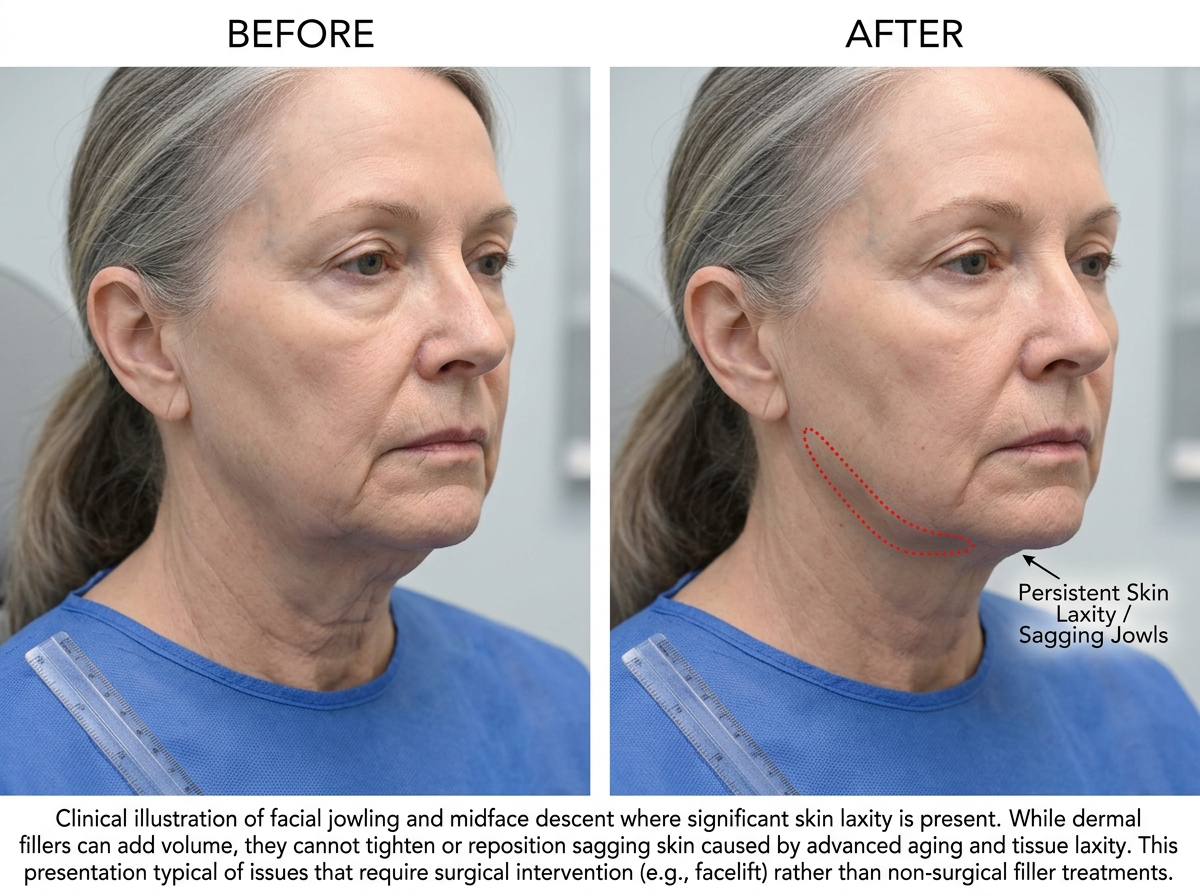
We often see patients in our Stuart and West Palm Beach offices who have been getting fillers for years. Eventually, they notice that the results don’t look as “fresh” as they used to. This is what we call “filler fatigue.”
1. The “Oval to Square” Transition
In our youth, the face typically follows an “inverted triangle” or “heart” shape—wide at the cheekbones and tapering to a crisp chin. As tissue laxity takes over, that volume migrates south. The jawline becomes heavy, and the face shape shifts from an oval to a square. If we try to fix this by simply adding more filler to the cheeks, we risk creating an unnaturally wide upper face without ever fixing the sagging jawline.
2. Chasing the Wrinkle
If you find yourself needing more and more syringes to “fill” a fold, you are likely chasing a symptom rather than the cause. Deep nasolabial folds are often caused by the cheek tissue sliding down. Filling the fold directly can eventually lead to a “muzzle” look. At this stage, lifting the tissue back to its original home is the only way to achieve a natural result, a finding supported by scientific research on facelift outcomes.
3. Filler Migration and Distortion
There is a limit to how much weight the skin can hold. When too much filler is used to try and “lift” the skin, the product can migrate or cause the face to look puffy and “pillowy,” especially when smiling. This distortion of facial proportions is a clear sign that the “liquid” approach has reached its boundaries.
The Longevity and Cost Reality of Facelift vs Fillers
When comparing facelift vs fillers, many people look only at the upfront price tag. However, we encourage our patients to look at the 10-year horizon.
The Maintenance Cycle
Dermal fillers are temporary. Depending on the product—whether it’s Juvederm, Restylane, or Voluma—you will likely need touch-ups every 9 to 18 months. Over a decade, these repeated treatments, plus the time spent in the chair, add up significantly.
The Cumulative Cost
While a liquid facelift is a lower initial investment, the cumulative cost of maintaining that look over 10 years can actually exceed the cost of a single surgical procedure. A deep plane facelift is a significant upfront investment, but its results are measured in decades, not months.
Furthermore, a facelift “sets back the clock.” While you will continue to age, you will always look roughly 10 years younger than you would have without the surgery. Fillers simply cannot provide that permanent structural “reset.”
Note: Pricing for these procedures varies based on the specific needs of the patient, the complexity of the case, and the geographic location of the practice. We invite you to contact Athena Plastic Surgery directly for a personalized consultation and accurate pricing information.
Modern Surgical Techniques: Beyond the “Pulled” Look
One of the biggest fears patients express is looking “windblown” or “operated on.” This fear usually stems from older techniques that relied solely on pulling the skin tight.
Modern plastic surgery has evolved. At Athena Plastic Surgery, we focus on the deeper layers of the face.
The SMAS and Deep Plane Approach
The “Gold Standard” for a natural look is the deep plane technique. Instead of just tightening the skin, we address the SMAS (Superficial Musculoaponeurotic System)—the sturdy layer of muscle and connective tissue beneath the skin.
In a deep plane facelift vs facelift (traditional), the deep plane approach releases the tension on the ligaments. This allows us to move the entire “unit” of the face—fat, muscle, and skin—back to a higher, more youthful position without any tension on the skin itself. This prevents the “pulled” look and ensures the results last much longer because the heavy lifting is done by the stronger, deeper tissues.
Recovery and Results: What to Expect
The “downtime” is often the deciding factor for our busy Florida patients.
Dermal Filler Recovery
Recovery is nearly immediate. You might have some slight swelling or a small bruise at the injection site, but most patients return to work the same or the next day. It is the ultimate “lunchtime” rejuvenation.
Facelift Recovery
A facelift requires more patience.
- Days 1–3: Expect some discomfort and swelling. We recommend keeping your head elevated.
- Week 1: Most sutures are removed. You’ll feel “tight” but the initial swelling begins to subside.
- Week 2: Most patients feel comfortable going to the grocery store or running errands. Bruising is usually manageable with a little concealer.
- Week 3: This is typically the “social recovery” mark where you can return to work and social engagements without people noticing you had “work done”—you’ll just look well-rested.
For more detailed guidance, you can review our facelift recovery tips to ensure your healing process is as smooth as possible.
Frequently Asked Questions about Facelift vs Fillers
Can I combine a facelift and fillers for better results?
Absolutely. In fact, we often recommend it. A facelift restores the position of the tissue, but it doesn’t always address the texture of the skin or the loss of volume in very specific areas like the lips or under the eyes.
Many patients choose to increase facial volume with dermal fillers or fat grafting during or after their surgery to add that final “polish.” Using fillers for fine-tuning after the heavy lifting of a facelift is done often produces the most harmonious, natural results.
At what age should I switch from fillers to a facelift?
There is no “magic number.” We have seen 45-year-olds with significant sun damage and skin laxity who are ready for a lift, and 60-year-olds with great skin elasticity who still do well with injectables.
The decision is based on your anatomy. If you can “lift” your jowls with two fingers and like what you see, but filler isn’t achieving that same look, it’s likely time for a surgical consultation. We offer 5 types of facelifts ranging from mini-lifts to full deep-plane procedures to match your specific stage of aging.
Is a facelift vs fillers more cost-effective over ten years?
Generally, yes. If you are using 4–6 syringes of filler a year to maintain your look, the math quickly favors surgery. While the upfront investment for surgery is higher, the “cost per year” over a decade is often lower than a high-maintenance filler routine.
However, cost-effectiveness also includes your “happiness ROI.” If fillers are no longer making you feel confident and you are “chasing” results, the investment in a more permanent solution often feels much more valuable. To understand the different applications, you can learn more about what areas can be treated with dermal fillers to see if your concerns are still within the “injectable zone.”
Conclusion
Choosing between a facelift vs fillers isn’t about which procedure is “better”—it’s about which one is right for your current stage of aging and your long-term aesthetic goals.
At Athena Plastic Surgery, we believe in a customized approach. Whether you are looking for the immediate, non-surgical refinement of fillers or the transformative, long-lasting results of a deep plane facelift, our team is dedicated to providing compassionate care and aesthetic excellence.
Dr. Avron Lipschitz and our staff are proud to serve the Stuart and West Palm Beach communities, helping our neighbors look and feel like the best versions of themselves. We invite you to take the next step in your journey. Schedule a consultation in West Palm Beach or Stuart today to discover the best path forward for your unique beauty.




